

Every culture has invisible rules.
How close should you stand?
When should you smile?
Is eye contact polite… or rude?
Nobody writes these rules down — but everyone expects you to understand them. Learn the language of culture shock and become an expert at understanding people anywhere in the world.
How close should you stand?
When should you smile?
Is eye contact polite… or rude?
Nobody writes these rules down — but everyone expects you to understand them. Learn the language of culture shock and become an expert at understanding people anywhere in the world.
Word bank:
1. General concepts

culture shock — [ˈkʌltʃə ʃɒk] — a feeling of confusion when experiencing a new culture; kultūršoks
Many students experience culture shock when they first study abroad.
experience — [ɪkˈspɪəriəns] — something that happens to you and influences how you think or feel; pieredze, gūt pieredzi
Travelling abroad can be an exciting experience.
2. Feelings in a new culture
Revise what you studied about feelings and emotions in form 3: Feelings and emotions

embarrassed — [ɪmˈbærəst] — feeling uncomfortable because of a mistake or misunderstanding; samulsis(usi)
People may feel embarrassed when they do not know social rules.

confused — [kənˈfjuːzd] — unable to understand something clearly; apjucis, apjukusi
New customs can sometimes make people feel confused.

curious — [ˈkjʊəriəs] — interested in learning something new; ziņkārīgs(a), zinātkārs(a)
He was curious about traditional food in the new country.

homesick — [ˈhəʊmsɪk] — feeling sad because you miss your home; noilgojies/noilgojusies pēc mājām
She felt homesick during her first weeks in another country.

lonely — [ˈləʊnli] — feeling unhappy because you are alone; vientuļš(a)
He was lonely before making new friends.

nervous — [ˈnɜːvəs] — worried about something new or unknown; nervozs(a), satraukts(a)
She felt nervous on her first day at a new school.

surprised — [səˈpraɪzd] — feeling unexpected emotion when something is different; pārsteigts(a)
Cultural differences can make people feel surprised.

uncomfortable — [ʌnˈkʌmftəbl] — feeling not relaxed or not confident; justies neērti, samulsis(usi)
She felt uncomfortable because she did not understand the social rules.

worried — [ˈwʌrid] — feeling concerned about a situation; noraizējies(usies), norūpējies(usies)
People may be worried when they do not understand the language.

stress — [stres] — mental pressure caused by difficult situations; stress
Moving to another country may cause stress at first.
3. Cultural differences in daily life

body language — [ˈbɒdi ˈlæŋɡwɪdʒ] — communication through gestures and movements; ķermeņa valoda
Eye contact is an important part of body language in many countries.

greeting style — [ˈɡriːtɪŋ staɪl] — the way people say hello; sasveicināšanās veids
Greeting styles differ across cultures.

personal space — [ˈpɜːsənəl speɪs] — the physical distance people prefer between each other; personīgā "telpa"
People may stand closer or further away depending on personal space rules.

social rules — [ˈsəʊʃəl ruːlz] — expected ways of behaving in society; sabiedriskās uzvedības normas
Social rules may be different in each culture.

table manners — [ˈteɪbl ˈmænəz] — rules about how to behave when eating; uzvedības normas pie galda
Table manners are not the same in all countries.
4. Adapting to a new culture

accept differences — [əkˈsept ˈdɪfrənsɪz] — to understand that people are not the same; pieņemt atšķirīgo
Accepting differences helps people feel comfortable.

keep an open mind — [kiːp ən ˈəʊpən maɪnd] — to be willing to understand new ideas; būt atvērtam(i) jaunām idejām
Keeping an open mind helps people learn about cultures.

solve problems — [sɒlv ˈprɒbləmz] — to find solutions to difficult situations; risināt problēmas
Communication helps solve problems.
5. Positive results of adaptation

feel proud — [fiːl praʊd] — to feel happy about achievements; būt lepnam(ai)
She felt proud after communicating successfully in a foreign language.

gain experience — [ɡeɪn ɪkˈspɪəriəns] — to learn from practical situations; (ie)gūt pieredzi
Travelling helps people gain experience.

develop skills — [dɪˈvel.əp skɪlz] — to develop new abilities; attīstīt, pilnveidot prasmes
New situations help people develop new skills.

make progress — [meɪk ˈprəʊɡres] — to improve step by step; progresēt, pilnveidoties
Language learners make progress through regular practice.
Atsauce:
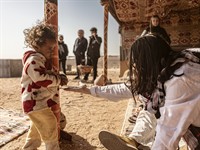
Picture “Child in a desert camp in Egypt”: pporiphotos / Shutterstock.com