


Emma: I really love English.
Noah wants to agree. What should he say?
Noah wants to agree. What should he say?
- Should he say “So do I”?
- Should he say “So am I”?
- Should he say “Neither do I”?
At first, all three replies may look possible. However, the correct choice depends on two important clues in Emma’s statement: whether it is positive or negative and which verb it contains.
Learn: in this unit, you will learn how to recognise these clues and form accurate responses with so and neither. Watch the video to discover how "so" and "neither" work.
Key Takeaways:
Agreement with a positive statement
I love sushi. — So do I.
I’m really tired today. — So am I.
Agreement with a negative statement
I don’t go to the cinema very often. — Neither do I.
I’m not very well at the moment. — Neither am I.
A: “I didn’t see the film yesterday.” B: “Neither did I.”
Choosing the Auxiliary Verb
In structures with "so" and "neither", the auxiliary verb depends on the tense and verb structure used in the first statement.
I am confident. — So am I.
They are working together. — So are we.
She wasn’t feeling well. — Neither was I.
Tom has completed the task. — So have I.
I can work independently. — So can I.
She won’t attend the meeting. — Neither will Anna.
Affirmative statements in the Present Simple and Past Simple often contain only a main verb. In responses with "so" or "neither", use:
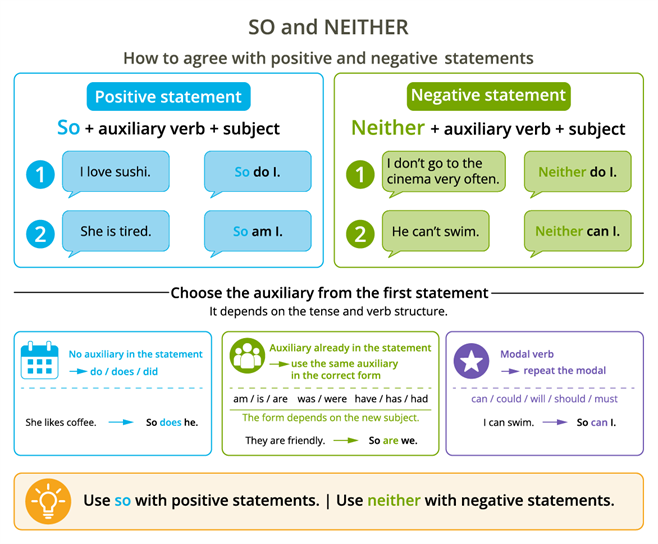
We use “so” and “neither” to show that we agree with another person.
Use: So + auxiliary verb + subject
I’m really tired today. — So am I.
Agreement with a negative statement
Use: Neither + auxiliary verb + subject
I’m not very well at the moment. — Neither am I.
Use "neither" when the first statement contains a negative form such as "don’t" or "not". "Neither" is a negative word, like "not". For this reason, the auxiliary verb after "neither" should be affirmative.
Choosing the Auxiliary Verb
In structures with "so" and "neither", the auxiliary verb depends on the tense and verb structure used in the first statement.
Step 1: Look for an auxiliary or modal verb. When the first statement already contains an auxiliary or modal verb, use the same one in the response. Auxiliary and modal verbs include: am, is, are, was, were, have, has, had, can, could, will, would, should and must
They are working together. — So are we.
She wasn’t feeling well. — Neither was I.
Tom has completed the task. — So have I.
I can work independently. — So can I.
She won’t attend the meeting. — Neither will Anna.
Step 2: Use "do", "does" or "did" when there is no auxiliary.
- "do" in the Present Simple with I, you, we and they;
- "does" in the Present Simple with he, she and it;
- "did" in the Past Simple with all subjects.
I enjoy teamwork. — So do I.
Anna works well under pressure. — So does Mark.
Tom completed the task early. — So did Marta.
Anna works well under pressure. — So does Mark.
Tom completed the task early. — So did Marta.
Negative statements in these tenses already contain "do", "does" or "did", so use the same auxiliary in the response.
I don’t enjoy noisy workplaces. — Neither do I.
Mia doesn’t like working alone. — Neither does Ben.
We didn’t understand the instructions. — Neither did they.
I don’t enjoy noisy workplaces. — Neither do I.
Mia doesn’t like working alone. — Neither does Ben.
We didn’t understand the instructions. — Neither did they.
Other tense structures normally already contain an auxiliary or modal verb, so follow Step 1 and repeat that verb.
Present Perfect: I have finished the task. — So have I.
Past Continuous: She was working late. — So was Tom.
Future Continuous: They will be travelling tomorrow. — So will we.
Past Continuous: She was working late. — So was Tom.
Future Continuous: They will be travelling tomorrow. — So will we.
In a nutshell:
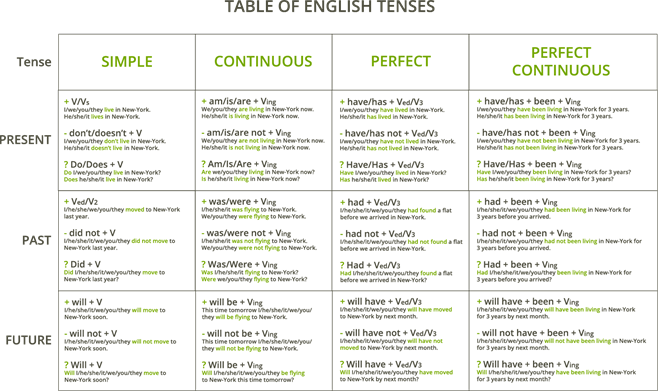
Revise how we form gramatical tenses so you can use auxiliary verbs correctly:
Atsauce:
BBC Learning English "So vs Neither – English In A Minute" (02.09.2020.), [video], YouTube