


Your phone displays four status messages:
Storage almost full: There are too many videos.
Battery at 7%: There is not enough power.
Connection stable: The internet is fast enough for streaming.
Volume at maximum: The music is too loud.
Storage almost full: There are too many videos.
Battery at 7%: There is not enough power.
Connection stable: The internet is fast enough for streaming.
Volume at maximum: The music is too loud.
Learn: every message describes a limit: more than is acceptable, less than is needed, or the right amount. In this unit, you will learn how "too", "enough" and "not enough" express these differences. Watch the video to discover how "too", "enough" and "not enough" express different limits and how their position changes with adjectives, adverbs and nouns.
Key Takeaways:
1. Meaning
The bag is too heavy.
1. Meaning
too = more than is wanted, needed or acceptable. This usually expresses a problem or negative result.
enough = the correct or necessary amount. This means the requirement has been met.
not enough = less than is wanted or needed. This means the requirement has not been met.
2. With adjectives and adverbs
Structure: too + adjective/adverb
She is driving too quickly.
Structure: adjective/adverb + enough
She speaks clearly enough.
Structure: not + adjective/adverb + enough
He did not answer quickly enough.
A negative sentence with "enough" can sometimes express a similar idea to "too"
I am too weak.
3. With nouns
There are too many students in the room.
She made too many mistakes.
There is too much noise.
We spent too much money.
too many + countable plural noun. Use "many" with nouns that can be counted
She made too many mistakes.
too much + uncountable noun. Use "much" with nouns that are not normally counted
We spent too much money.
Revise: you studied about countable and uncountable nouns in Form 6. Time to revise: Countable and Uncountable Nouns. You also studied about "much" and "many": Quantifiers: Some, Any, Much, Many, A lot of, A few, A little
enough + noun. With nouns, "enough" comes before the noun
There is enough time.
4. Negative sentences with nouns
We do not have enough chairs.
She does not have enough experience.
There is not enough food.
There are not enough tables.
"Not" is usually placed before the main verb
She does not have enough experience.
When "be" is the main verb, "not" comes after it
There are not enough tables.
In a nutshell:
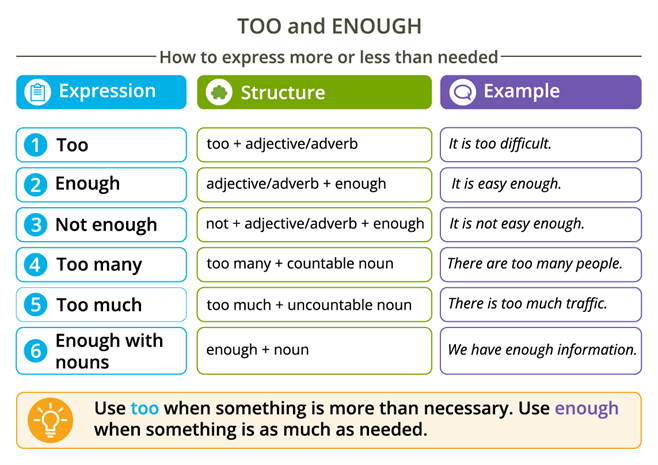
Revise adverbs that you studied about in Form 7: Adverbs
Atsauce:
mmmEnglish "How To Use TOO & ENOUGH | English Grammar Lesson" (25.11.2017.), [video], YouTube