


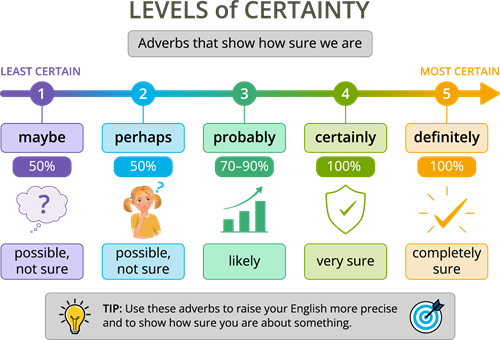
Will you definitely remember everything you learn today? Probably. Will you make no mistakes at all? Perhaps — but maybe not! We do not always feel equally sure about what we say. Sometimes we are completely certain, sometimes we think something is likely, and sometimes we only see it as a possibility. Words such as "definitely", "certainly", "probably", "perhaps" and "maybe" help us show exactly how sure we are. In this unit, you will learn how these adverbs change the meaning of a sentence and where to place them correctly.
Revise: you are already familiar with adverbs. Remember old good times from Form 7? Revise it here: Adverbs
Let's dive in!
perhaps — [pəˈhæps] — used to say that something may be true or may happen, but you are not sure; varbūt, iespējams
Perhaps Liam will apply for a summer job.
maybe — [ˈmeɪ.bi] — used to say that something is possible, but you are not certain that it will happen or is true (50% sure); varbūt, iespējams, laikam
Maybe Noah will choose a career in construction.
probably — [ˈprɒb.ə.bli] — used to say that something is likely to happen or be true (70 — 90% sure); laikam, varbūt, visticamāk, droši vien
Maya will probably choose a career in healthcare.
certainly — [ˈsɜː.tən.li] — used to show that you are very sure that something is true or will happen; protams, noteikti, pavisam droši
The new skills will certainly help Noah in his future job.
definitely — [ˈdef.ɪ.nət.li] — used to say that you are completely sure about something (100% sure); noteikti, pilnīgi noteikti
Ella definitely wants to work with animals.
In a nutshell:
Main sentence position rules
Ella definitely wants to study medicine.
Tom probably knows the answer.
The team certainly needs more time.
1. Before the main verb. Subject + adverb + main verb
Tom probably knows the answer.
The team certainly needs more time.
2. After the verb "be" forms. Subject + be + adverb
The information is probably correct.
They are certainly experienced.
3. After an auxiliary or modal verb. Subject + auxiliary/modal + adverb + main verb
They have definitely completed the task.
He can certainly explain the problem.
4. “Certainly” usually comes in the middle of a sentence, but it can come at the beginning to emphasise the speaker’s confidence. When “certainly” comes at the beginning of a sentence it is followed by a comma
Certainly, this experience will help her in the future.
Certainly, they have enough experience for the job.
5. "Maybe" and "perhaps" usually come at the beginning of the sentence.
Perhaps Noah isn’t ready for the interview.
6. In negative sentences, "probably", "certainly" and "definitely" usually come before the negative auxiliary verb: subject + adverb + negative auxiliary + main verb
They certainly have not finished the task.
7. With the verb "be" forms, the adverb can come after "be" and before "not"
They are definitely not interested in the position.
8. The adverb can also come before a contracted negative form
They definitely haven’t completed the task.
9. "Maybe" and "perhaps" usually come at the beginning of a negative sentence
Perhaps Ava is not interested in the position.