

Read and listen to the story. Pay attention to the highlighted words.
The Watchtower in the Mist
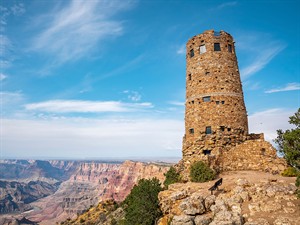
Sophie and her older brother, Daniel, were climbing Grey Hill to find an abandoned watchtower. Their grandfather had told them that he had hidden a small metal box there many years earlier.
At first, the path was easy to follow. However, thick mist soon covered the hill, and the signs disappeared from view. While Daniel was studying the map, Sophie noticed a narrow track between the trees. They followed it, but when they reached a deep stream, they realised that they had taken the wrong path. A sudden gust of wind lifted the mist and revealed the watchtower on the hillside. As soon as Sophie spotted it, she grabbed Daniel’s arm and pointed towards it. Then, they climbed carefully up the rocky slope.
Later, they found the metal box beneath a broken step inside the tower. It contained an old photograph, a note and a compass. Finally, the mist began to clear, and the compass helped them find their way home before dark.
At first, the path was easy to follow. However, thick mist soon covered the hill, and the signs disappeared from view. While Daniel was studying the map, Sophie noticed a narrow track between the trees. They followed it, but when they reached a deep stream, they realised that they had taken the wrong path. A sudden gust of wind lifted the mist and revealed the watchtower on the hillside. As soon as Sophie spotted it, she grabbed Daniel’s arm and pointed towards it. Then, they climbed carefully up the rocky slope.
Later, they found the metal box beneath a broken step inside the tower. It contained an old photograph, a note and a compass. Finally, the mist began to clear, and the compass helped them find their way home before dark.
In “The Watchtower in the Mist,” some words and phrases were highlighted. These words help us understand how events are connected and in what order they happen. They belong to two groups:
- conjunctions — “when,” “while” and “as soon as”;
- sequencers — “at first,” “then,” “later” and “finally.”
A conjunction joins two parts of a sentence and shows the time relationship between two events.
"While Daniel was studying the map, Sophie noticed a narrow track."
This sentence contains two events:
This sentence contains two events:
- Daniel was studying the map.
- Sophie noticed a narrow track.
Sequencers, also called sequencing words, show the order in which events happen. They guide the reader through a story from the beginning to the end.
"At first, the path was easy to follow."
"Then, Sophie and Daniel climbed up the rocky slope."
"Later, they found the metal box."
"Finally, they found their way home."
"Then, Sophie and Daniel climbed up the rocky slope."
"Later, they found the metal box."
"Finally, they found their way home."
1. Conjunctions
when — [wen] — used to introduce an event or situation that shows the time at which another event happens; kad
"When Sophie reached the stream, she stopped." Sophie first reached the stream. At that moment, she stopped. The event after “when” tells us when the other event happened.
"Daniel looked up when Sophie called his name." Here, Sophie’s call shows the moment at which Daniel looked up.
"Daniel looked up when Sophie called his name." Here, Sophie’s call shows the moment at which Daniel looked up.
while — [waɪl] — used to show that one action happens during the same period of time as another action that is already in progress; kamēr
"While Daniel was studying the map, Sophie looked around." Daniel’s action continued for some time. During that same period, Sophie looked around. The two actions happened at the same time.
"Sophie noticed a narrow track while Daniel was checking the map." Here, Daniel was already checking the map when Sophie noticed the track.
"Sophie noticed a narrow track while Daniel was checking the map." Here, Daniel was already checking the map when Sophie noticed the track.
as soon as — [əz ˈsuːn əz] — used to show that one event happens immediately after another event, with almost no time between them; tiklīdz
"As soon as Sophie spotted the watchtower, she grabbed Daniel’s arm." Sophie first spotted the watchtower. Immediately afterwards, she grabbed Daniel’s arm. Almost no time passed between the two events.
"Daniel opened the box as soon as he found the key." Here, Daniel opened the box immediately after finding the key.
"Daniel opened the box as soon as he found the key." Here, Daniel opened the box immediately after finding the key.
Position in the Sentence
A sentence with “when,” “while” or “as soon as” usually has two parts:
A sentence with “when,” “while” or “as soon as” usually has two parts:
- a time clause*, which begins with the conjunction;
- a main clause, which gives the main event.
The time clause can come first or second. The meaning usually stays the same, but the punctuation changes.
When the time clause comes first, put a comma after it: Time clause + comma + main clause
While Daniel was studying the map, Sophie looked around.
When the time clause comes second, a comma is not normally used: Main clause + time clause
Sophie looked around while Daniel was studying the map.
Svarīgi!
*Recognising a Clause
This sentence has two clauses:
when Sophie reached the stream — subject: Sophie; verb: reached
she stopped — subject: she; verb: stopped
A clause is a group of words with a subject and a verb.
When Sophie reached the stream, she stopped.This sentence has two clauses:
when Sophie reached the stream — subject: Sophie; verb: reached
she stopped — subject: she; verb: stopped
Tenses with Time Conjunctions
Past
When the mist appeared, Sophie stopped walking.
While Daniel was studying the map, Sophie was looking for the path.
As soon as they had found the box, they left the tower.
Present
When I walk in the forest, I always take a map.
While Sophie is checking the compass, Daniel is watching the path.
Future
Past
When the mist appeared, Sophie stopped walking.
While Daniel was studying the map, Sophie was looking for the path.
As soon as they had found the box, they left the tower.
Present
When I walk in the forest, I always take a map.
While Sophie is checking the compass, Daniel is watching the path.
Future
When “when,” “while” or “as soon as” introduces a future event, use the Present Simple in the time clause. Use “will” + base form of the verb in the main clause. When the time clause comes first, use a comma after it.
time conjunction + subject + Present Simple / subject + “will” + base verb
When the mist clears, they will continue walking.
They will look for the box as soon as they reach the tower.
They will look for the box as soon as they reach the tower.
2. Time Sequencers
at first — [ət ˈfɜːst] — used to describe the situation at the beginning, especially when it changes later; sākumā
"At first, the path was easy to follow." The path was easy at the beginning, but this situation changed when the mist covered the hill.
then — [ðen] — used to introduce the next event or action in a sequence; tad, pēc tam
"Then, Sophie and Daniel climbed up the rocky slope." This happened after the event described before it.
later — [ˈleɪ.tə(r)] — used to introduce an event that happens after some time has passed; vēlāk
"Later, they found the metal box inside the tower." The box was not found immediately. Some time passed before they found it.
finally — [ˈfaɪ.nəl.i] — used to introduce the last event or result in a sequence, often after several earlier events or difficulties; visbeidzot, beidzot
"Finally, Sophie and Daniel found their way home." This was the last important event in their adventure.
Quick Comparison
“at first” — the situation at the beginning;
“then” — the next event;
“later” — an event after some time has passed;
“finally” — the last event or result.
Quick Comparison
“at first” — the situation at the beginning;
“then” — the next event;
“later” — an event after some time has passed;
“finally” — the last event or result.
These sequencers usually come at the beginning of a sentence. When they come first, use a comma after them.
At first, the path was clear.
Then, the mist appeared.
Later, they reached the tower.
Finally, they returned home.
Then, the mist appeared.
Later, they reached the tower.
Finally, they returned home.