

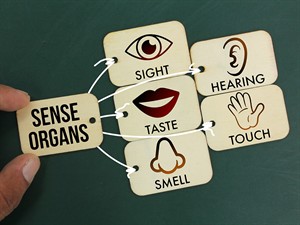
Every second, your brain receives information through sight, hearing, smell, taste and touch. These senses do not work separately. Your brain combines their messages to create a detailed picture of what is happening around you.
Sight provides a huge amount of information. Imagine standing at the top of a hill. You might see a broad valley below and an enormous mountain in the distance. A steep, crooked path may lead down towards a lake. In sunlight, the water can look bright and shiny, while objects in the shade may appear dull or pale. Things far away can become blurry, and a building that looks huge from nearby may seem much smaller from a distance. Your brain constantly uses these visual clues to judge size, shape and distance.
Hearing gives you information that your eyes cannot. A bird may make a high-pitched sound, while thunder produces a low-pitched rumble. Changes in volume help you understand whether a sound is moving closer or farther away. You may even recognise a familiar voice without seeing the speaker. Surprisingly, silence can also tell us something: when a normally noisy place suddenly becomes quiet, we often notice it immediately.
Our sense of smell can react very quickly to danger. A burning smell, for example, may warn you about a fire before you see any smoke. Some smells are fresh and pleasant, while others are nasty or unpleasant. A smell can also be very strong, and some chemicals have a sharp smell that makes us move away.
Taste works closely with smell. In fact, much of what we call flavour comes from information received by both the tongue and the nose. Food may taste fruity, sharp or quite plain. A ripe peach can be sweet and juicy, while a simple meal can still be very tasty. This is why food often seems to have less flavour when your nose is blocked.
Finally, touch helps us understand both the outside world and our own bodies. Our skin can quickly tell the difference between a rough rock and a smooth surface, or warn us that something is sticky. In very cold weather, your fingers may feel almost frozen. Touch also gives us information from inside the body. After exercise, muscles may feel sore or tight. When people are worried or under pressure, their shoulders and neck may become tense without them even noticing.
Together, our senses collect thousands of pieces of information every minute. The brain then connects them, helping us understand our surroundings, recognise danger and experience the world in remarkable detail.
Sight provides a huge amount of information. Imagine standing at the top of a hill. You might see a broad valley below and an enormous mountain in the distance. A steep, crooked path may lead down towards a lake. In sunlight, the water can look bright and shiny, while objects in the shade may appear dull or pale. Things far away can become blurry, and a building that looks huge from nearby may seem much smaller from a distance. Your brain constantly uses these visual clues to judge size, shape and distance.
Hearing gives you information that your eyes cannot. A bird may make a high-pitched sound, while thunder produces a low-pitched rumble. Changes in volume help you understand whether a sound is moving closer or farther away. You may even recognise a familiar voice without seeing the speaker. Surprisingly, silence can also tell us something: when a normally noisy place suddenly becomes quiet, we often notice it immediately.
Our sense of smell can react very quickly to danger. A burning smell, for example, may warn you about a fire before you see any smoke. Some smells are fresh and pleasant, while others are nasty or unpleasant. A smell can also be very strong, and some chemicals have a sharp smell that makes us move away.
Taste works closely with smell. In fact, much of what we call flavour comes from information received by both the tongue and the nose. Food may taste fruity, sharp or quite plain. A ripe peach can be sweet and juicy, while a simple meal can still be very tasty. This is why food often seems to have less flavour when your nose is blocked.
Finally, touch helps us understand both the outside world and our own bodies. Our skin can quickly tell the difference between a rough rock and a smooth surface, or warn us that something is sticky. In very cold weather, your fingers may feel almost frozen. Touch also gives us information from inside the body. After exercise, muscles may feel sore or tight. When people are worried or under pressure, their shoulders and neck may become tense without them even noticing.
Together, our senses collect thousands of pieces of information every minute. The brain then connects them, helping us understand our surroundings, recognise danger and experience the world in remarkable detail.
Key vocabulary:
hearing — [ˈhɪə.rɪŋ] — the ability to hear sounds; dzirde
sight — [saɪt] — the ability to see; redze
smell — [smel] — the sense that allows you to notice and recognise odours through your nose; oža
taste — [teɪst] — the sense that allows you to recognise the flavour of food and drink; garša
touch — [tʌtʃ] — the sense that allows you to feel things through physical contact with your body, especially your skin; tauste
sight — [saɪt] — the ability to see; redze
smell — [smel] — the sense that allows you to notice and recognise odours through your nose; oža
taste — [teɪst] — the sense that allows you to recognise the flavour of food and drink; garša
touch — [tʌtʃ] — the sense that allows you to feel things through physical contact with your body, especially your skin; tauste
blurry — [ˈblɜː.ri] — not clear or sharp, so that details are difficult to see; izplūdis, neskaidrs
bright — [braɪt] — giving or reflecting a lot of light; spilgts, gaišs
broad — [brɔːd] — wide from one side to the other; plats, plašs
crooked — [ˈkrʊk.ɪd] — not straight; bent or twisted; šķībs, līks
dull — [dʌl] — not bright, clear or shiny; blāvs, nespodrs
enormous — [ɪˈnɔː.məs] — extremely large; milzīgs, ārkārtīgi liels
huge — [hjuːdʒ] — very large in size or amount; milzīgs, ļoti liels
pale — [peɪl] — light in colour and not bright or strong; bāls, gaišs
shiny — [ˈʃaɪ.ni] — having a smooth surface that reflects light; spīdīgs, mirdzošs
steep — [stiːp] — rising or falling at a sharp angle; stāvs
Hearing

high-pitched — [ˌhaɪˈpɪtʃt] — having a high, often sharp sound; augsts, spalgs (par skaņu)
low-pitched — [ˌləʊˈpɪtʃt] — having a low, deep sound; zems, dobjš (par skaņu)
silence — [ˈsaɪ.ləns] — a complete absence of sound or noise; klusums
voice — [vɔɪs] — the sound produced by a person when they speak or sing; balss
volume — [ˈvɒl.juːm] — the level of loudness of a sound; skaļums
Smell

burning — [ˈbɜː.nɪŋ] — having a smell that suggests something is burning or has been burnt; deguma, piedeguma
fresh — [freʃ] — having a clean and pleasant smell; svaigs, patīkami smaržojošs
nasty — [ˈnɑː.sti] — having a very unpleasant smell; nejauks, nepatīkams
sharp — [ʃɑːp] — having a strong smell that is easy to notice and may be slightly unpleasant; ass, kodīgs
strong — [strɒŋ] — having a smell that is very noticeable or powerful; stiprs, izteikts
unpleasant — [ʌnˈplez.ənt] — having a smell that is not nice or enjoyable; nepatīkams
Taste

Taste
flavour — [ˈfleɪ.və] — the particular taste of a food or drink; garša, garšas īpašības
fruity — [ˈfruː.ti] — tasting or smelling like fruit; ar augļu garšu
juicy — [ˈdʒuː.si] — containing a lot of juice and pleasant to eat; sulīgs
plain — [pleɪn] — simple and without strong flavours or extra ingredients; vienkāršs, bez izteiktām garšvielām vai piedevām
sharp — [ʃɑːp] — having a strong and noticeable taste; ass, izteikts
tasty — [ˈteɪ.sti] — having a pleasant and enjoyable flavour; garšīgs, gards
Revise adjectives related to food: How to talk about likes and dislikes and describe food using adjectives
Touch and Physical Sensations

frozen — [ˈfrəʊ.zən] — extremely cold or feeling unable to move because of cold or fear; nosalis, sastindzis
rough — [rʌf] — not smooth; having an uneven surface; raupjš, nelīdzens
smooth — [smuːð] — having an even surface with no rough parts; gluds
sore — [sɔː] — painful or uncomfortable, especially when touched or moved; sāpīgs, jūtīgs
sticky — [ˈstɪk.i] — tending to stick to things when touched; lipīgs
tense — [tens] — feeling that your muscles are tight or stiff, often because you are nervous, worried or under pressure; saspringts
tight — [taɪt] — feeling firmly stretched or pressed, especially in a muscle or part of the body; savilkts, saspringts
Talking About Sensory Information
When we describe sensory experiences, we can use more than the basic verbs see, hear, smell, taste and feel. The following verbs help us explain when we become aware of something, identify something familiar, experience a sensation or understand something from the information our senses give us.
When we describe sensory experiences, we can use more than the basic verbs see, hear, smell, taste and feel. The following verbs help us explain when we become aware of something, identify something familiar, experience a sensation or understand something from the information our senses give us.
experience + noun — when you feel a particular physical sensation or condition
experience + adjective + noun — when you describe the particular type or strength of a sensation
notice a/an + adjective + smell / sound / sensation — when you become aware of and describe a sensory detail
notice the smell / sound of + noun — when you specify what produces or is associated with the smell or sound
notice + change / difference in — when your senses help you become aware that something has changed
recognise + person / thing / voice / smell / sound — when you identify something because it is familiar to you
recognise the smell / sound / taste of + noun — when you identify a familiar sensory experience and say what it is
recognise someone/something by + sensory clue — when a particular sensory detail helps you identify someone or something
realise (that) + clause — when sensory information helps you understand that something is true or happening
realise + wh-clause* — when you understand a detail or situation as a result of the information you receive
*A wh-clause is a dependent clause that begins with a wh-word such as who, what, where, when, why, how, which or whose. It gives information about a person, thing, place, time, reason, way, choice or possession.
I know where she lives.
We understood why the alarm sounded.
She realised who was speaking.
They discovered how the machine works.
We understood why the alarm sounded.
She realised who was speaking.
They discovered how the machine works.
Formation
1. The wh-word is not the subject: wh-word + subject + verb + ... Use statement word order, not question word order.
I realised where the sound is coming from.
2. The wh-word is the subject. Then there is no separate subject after it: wh-word + verb + ...
She realised who is speaking.
Practice: now that you have explored how the five senses work and learned useful vocabulary and patterns for describing sensory experiences, finish the unit by discussing the questions below. Develop your answers by explaining your ideas, giving reasons and supporting them with relevant examples. You can also use the model answers for studying purposes and as examples of how to organise and develop a strong response.
1. Which sense would be the most difficult to live without? Why?
"In my view, sight would be the most difficult sense to lose because we rely on it for a large part of our daily communication and movement. Without sight, it would be harder to notice changes in our surroundings, recognise people from a distance or move around independently. However, people can often develop other senses more strongly and learn to manage everyday situations in different ways."
2. Why can the same smell, taste or sound create very different reactions in different people?
"From my perspective, sensory experiences are closely connected with memory and personal experience. Someone might recognise the smell of a particular food and immediately remember a family celebration, while another person may find the same smell unpleasant. People can also experience strong reactions to certain sounds or flavours simply because they associate them with different situations from the past."
3. How do our senses help us recognise danger before we fully understand what is happening?
"I would say that our senses often provide the first warning signs of danger. For example, we may notice a strong burning smell, hear an unusual sound or experience a sharp physical sensation before we know exactly what is wrong. We may then realise that something is dangerous and react before the situation becomes more serious."
"In my view, sight would be the most difficult sense to lose because we rely on it for a large part of our daily communication and movement. Without sight, it would be harder to notice changes in our surroundings, recognise people from a distance or move around independently. However, people can often develop other senses more strongly and learn to manage everyday situations in different ways."
2. Why can the same smell, taste or sound create very different reactions in different people?
"From my perspective, sensory experiences are closely connected with memory and personal experience. Someone might recognise the smell of a particular food and immediately remember a family celebration, while another person may find the same smell unpleasant. People can also experience strong reactions to certain sounds or flavours simply because they associate them with different situations from the past."
3. How do our senses help us recognise danger before we fully understand what is happening?
"I would say that our senses often provide the first warning signs of danger. For example, we may notice a strong burning smell, hear an unusual sound or experience a sharp physical sensation before we know exactly what is wrong. We may then realise that something is dangerous and react before the situation becomes more serious."