

Imagine that you are reporting what happened during an education fair. The hall was crowded, music was playing and students were exploring the displays when the lights suddenly went out. To describe the scene clearly, you need two familiar tenses: the Past Simple and the Past Continuous. Compare:
The lights suddenly went out during the robotics demonstration.
At that moment, several students were testing a robot.
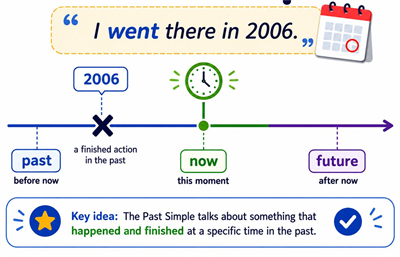
Revise: you have already studied both tenses. Before we explore how they work together, let us revisit their key ideas that you covered about Past Simple in Form 8: Past Simple, Common Irregular Verbs. Table
The lights suddenly went out during the robotics demonstration.
At that moment, several students were testing a robot.
Revise: you have already studied both tenses. Before we explore how they work together, let us revisit their key ideas that you covered about Past Simple in Form 8: Past Simple, Common Irregular Verbs. Table
In a nutshell:
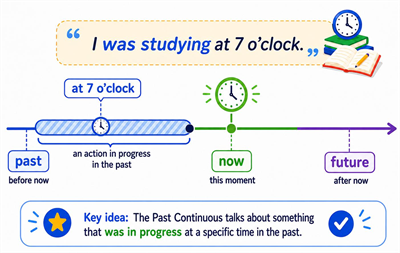
Revise: what you studied about Past Continuous: Past Continuous
In a nutshell:
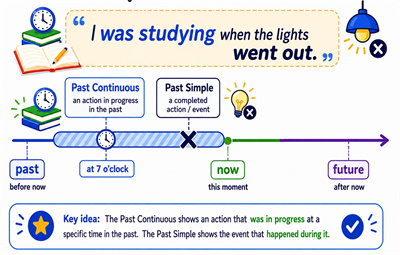
Sometimes a past event does not happen on its own. It takes place while another action is already in progress. Compare: I was studying when the lights went out.
The sentence contains two different actions:
The sentence contains two different actions:
- "was studying" — an action that was already in progress;
- "went out" — a completed event that happened during that action
The two tenses help us see the whole situation clearly.
1. The main rule
The students were testing a robot when the lights went out. (The students had already started testing the robot. The power cut happened while the activity was in progress.)
Use the Past Continuous for the action that was already in progress. Use the Past Simple for the event that happened during it. Pattern: Past Continuous + when + Past Simple
2. Background action and main event
Emily was speaking to a teacher when she heard a loud crash.
Background action: Emily was speaking to a teacher.
Main event: She heard a loud crash.
The crash did not need a long time to happen. It appeared as a new event during the conversation.
Think of the Past Continuous as the background of the scene. Think of the Past Simple as the event that moves the story forward.
Background action: Emily was speaking to a teacher.
Main event: She heard a loud crash.
The crash did not need a long time to happen. It appeared as a new event during the conversation.
3. Using "when"
Use "when" to introduce the event that happened during an action already in progress. Pattern: subject + was / were + verb-ing + when + subject + past verb / When + subject + past verb, subject + was / were + verb-ing
Punctuation rule: the comma is needed when the clause beginning with "when" comes first. No comma is needed when it comes second.
The visitors were exploring the displays when the music stopped.
When the lights went out, the dancers were rehearsing.
4. Using "while"
Use "while" to introduce the action that was already in progress. Pattern: While + subject + was / were + verb-ing, subject + past verb / subject + past verb + while + subject + was / were + verb-ing
Punctuation rule: when the clause beginning with "while" comes first, use a comma. When it comes second, no comma is needed.
While the students were exploring the displays, the music stopped.
My phone rang while I was walking towards the stage.
My phone rang while I was walking towards the stage.
5. Using "as"
Use "as" in a similar way to "while" when two things happen at approximately the same time.
The teacher noticed the problem as she was walking towards the stage.
6. Using "just as"
Just as the speaker was beginning her presentation, the microphone stopped working.
The lights went out just as the dancers were stepping onto the stage.
This expression makes the situation more dramatic and works well in stories.
Use "just as" when one event happens at the exact moment that another action is taking place.
The lights went out just as the dancers were stepping onto the stage.
This expression makes the situation more dramatic and works well in stories.
7. The same situation, two possible sentence structures
Both structures can describe the same situation.
The students were testing a robot when the lights went out.
While the students were testing a robot, the lights went out.
The meaning is almost the same. The difference is the order in which the information is presented.
Both structures can describe the same situation.
The students were testing a robot when the lights went out.
While the students were testing a robot, the lights went out.
The meaning is almost the same. The difference is the order in which the information is presented.
Svarīgi!
Be careful: "when" does not automatically mean Past Simple. The word "when" often introduces a Past Simple event, but the tense depends on the meaning of the sentence.
I was studying when the lights went out. (The lights went out during an activity already in progress.)
When I was studying, my brother called me. (The clause beginning with "when" contains the Past Continuous because it describes the background action.)
Remember: do not choose the tense only because you see "when" or "while". First decide which action was already in progress and which event happened during it.
8. A small change can change the meaning
Changing the tense can change the order of events. Compare:
When Emily entered the hall, the musicians were performing. (The performance had already started before Emily entered.)
When Emily entered the hall, the musicians performed. (The musicians performed after Emily entered.)
Changing the tense can change the order of events. Compare:
When Emily entered the hall, the musicians were performing. (The performance had already started before Emily entered.)
When Emily entered the hall, the musicians performed. (The musicians performed after Emily entered.)

1. Time expressions commonly used with the Past Continuous
These expressions show that an action was in progress at a particular moment or during a particular period in the past.
At a specific time
At seven o’clock, the students were rehearsing for the performance.
At that moment, the organisers were checking the equipment.
This time yesterday, I was preparing for the entrance exam.
During a period of time
The students were practising all afternoon.
Emily was studying from six until eight o’clock.
The organisers were answering questions throughout the event.
These expressions do not necessarily tell us when the action started or finished. They focus on the activity while it was in progress.
These expressions show that an action was in progress at a particular moment or during a particular period in the past.
At a specific time
At seven o’clock, the students were rehearsing for the performance.
At that moment, the organisers were checking the equipment.
This time yesterday, I was preparing for the entrance exam.
During a period of time
The students were practising all afternoon.
Emily was studying from six until eight o’clock.
The organisers were answering questions throughout the event.
These expressions do not necessarily tell us when the action started or finished. They focus on the activity while it was in progress.
2. Time expressions commonly used with the Past Simple
These expressions usually refer to a completed past action or a finished period of time.
The students visited the fair yesterday.
Emily enrolled in the course last year.
The presentation started two minutes ago.
The school opened in 2006.
The technician repaired the equipment on Saturday.
Words such as "suddenly" and "then" are also common in stories because they introduce completed events that move the action forward.
The students were watching the demonstration when the lights suddenly went out.
The technician opened the control box and then restarted the system.
These expressions usually refer to a completed past action or a finished period of time.
The students visited the fair yesterday.
Emily enrolled in the course last year.
The presentation started two minutes ago.
The school opened in 2006.
The technician repaired the equipment on Saturday.
Words such as "suddenly" and "then" are also common in stories because they introduce completed events that move the action forward.
The students were watching the demonstration when the lights suddenly went out.
The technician opened the control box and then restarted the system.