

Imagine stepping into a hotel where the temperature never rises above zero and your bedroom sparkles like a frozen crystal palace. Read the text about the Icehotel in Sweden carefully. Then answer multiple-choice questions.
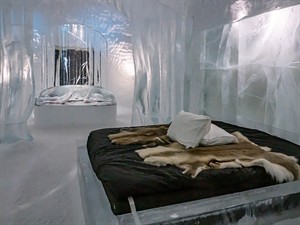
Would you dare to sleep in a room where the walls, the bed, and even the decorations are made entirely of ice? In northern Sweden, about 200 kilometres above the Arctic Circle, travellers can experience exactly that at the Icehotel – a hotel that is rebuilt every winter using ice from the nearby Torne River.
Unlike traditional hotels with carpeted corridors and hardwood floors, the Icehotel offers rooms constructed from blocks of frozen water. The floors are made of compacted snow and ice, covered only with thermal materials to prevent guests from slipping. As a result, features such as a parquet floor or carpeted surfaces are simply impossible in this environment.
Although the temperature inside the rooms remains between –5°C and –8°C, guests do not actually sleep directly on ice. Each bed consists of an ice base topped with a thick mattress and special thermal sleeping bags designed for Arctic conditions. Heating is not installed inside the individual ice rooms, because any permanent heating system would slowly melt the structure itself.
Most of the standard ice rooms do not include an en suite bathroom. Instead, guests use heated shared bathroom facilities located in a separate building nearby. This design prevents plumbing systems from freezing. However, the hotel also offers a small number of luxury suites that combine ice design with insulated sections, allowing for limited modern conveniences.
The Icehotel does not provide sea views, city views, or landmark views in the traditional sense. Instead, guests look out onto a vast snow landscape, frozen forests, and sometimes even the northern lights. For many visitors, this natural Arctic scenery is more impressive than any garden view or inner courtyard view.
Despite its unusual structure, the hotel does not ignore modern expectations. High-speed internet is available in common areas, and upper floors are accessible by elevator in the permanent part of the complex. A concierge assists guests with booking winter activities such as dog sledding and ice sculpting workshops. Bellhops help carry luggage, since pulling heavy suitcases across snow and ice can be difficult.
There is no traditional outdoor dining area during the coldest months, but the hotel’s famous ice bar serves complimentary drinks in glasses carved from ice. Visitors can also relax in a heated wellness centre and sauna after spending time outdoors in freezing temperatures.
The Icehotel may not offer a kitchenette in every room or interconnected rooms for large families, yet it attracts thousands of guests each year. Many travellers describe the experience as surprisingly comfortable and even hypoallergenic, as the cold air reduces dust and allergens.
Spending a night here requires preparation and flexibility. Early check-in is sometimes limited due to the delicate nature of the ice structures, and valet parking is less relevant in a snowy landscape where most guests arrive by shuttle service from the airport.
In the end, the Icehotel challenges traditional definitions of comfort. It replaces carpeted floors with frozen surfaces, private bathrooms with shared facilities, and city skylines with Arctic silence. Yet for those seeking something extraordinary, it offers a form of luxury that cannot be found anywhere else.
Unlike traditional hotels with carpeted corridors and hardwood floors, the Icehotel offers rooms constructed from blocks of frozen water. The floors are made of compacted snow and ice, covered only with thermal materials to prevent guests from slipping. As a result, features such as a parquet floor or carpeted surfaces are simply impossible in this environment.
Although the temperature inside the rooms remains between –5°C and –8°C, guests do not actually sleep directly on ice. Each bed consists of an ice base topped with a thick mattress and special thermal sleeping bags designed for Arctic conditions. Heating is not installed inside the individual ice rooms, because any permanent heating system would slowly melt the structure itself.
Most of the standard ice rooms do not include an en suite bathroom. Instead, guests use heated shared bathroom facilities located in a separate building nearby. This design prevents plumbing systems from freezing. However, the hotel also offers a small number of luxury suites that combine ice design with insulated sections, allowing for limited modern conveniences.
The Icehotel does not provide sea views, city views, or landmark views in the traditional sense. Instead, guests look out onto a vast snow landscape, frozen forests, and sometimes even the northern lights. For many visitors, this natural Arctic scenery is more impressive than any garden view or inner courtyard view.
Despite its unusual structure, the hotel does not ignore modern expectations. High-speed internet is available in common areas, and upper floors are accessible by elevator in the permanent part of the complex. A concierge assists guests with booking winter activities such as dog sledding and ice sculpting workshops. Bellhops help carry luggage, since pulling heavy suitcases across snow and ice can be difficult.
There is no traditional outdoor dining area during the coldest months, but the hotel’s famous ice bar serves complimentary drinks in glasses carved from ice. Visitors can also relax in a heated wellness centre and sauna after spending time outdoors in freezing temperatures.
The Icehotel may not offer a kitchenette in every room or interconnected rooms for large families, yet it attracts thousands of guests each year. Many travellers describe the experience as surprisingly comfortable and even hypoallergenic, as the cold air reduces dust and allergens.
Spending a night here requires preparation and flexibility. Early check-in is sometimes limited due to the delicate nature of the ice structures, and valet parking is less relevant in a snowy landscape where most guests arrive by shuttle service from the airport.
In the end, the Icehotel challenges traditional definitions of comfort. It replaces carpeted floors with frozen surfaces, private bathrooms with shared facilities, and city skylines with Arctic silence. Yet for those seeking something extraordinary, it offers a form of luxury that cannot be found anywhere else.
1. Why are parquet or carpeted floors not used in the ice rooms?
2. Why is permanent heating not installed inside the ice rooms?
3. What idea about “comfort” does the text mainly suggest?
Atsauce:
Picture “Ice hotel in Sweden”: Nowaczyk / Shutterstock.com
Lai iesniegtu atbildi un redzētu rezultātus, Tev nepieciešams autorizēties. Lūdzu, ielogojies savā profilā vai reģistrējies portālā!