

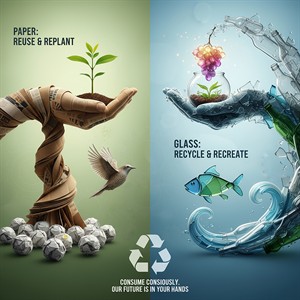
Think! An old newspaper can become something new. A glass bottle can be recycled and recreated. Even a small decision can help protect the environment. Look at the image and think about your own habits:
Do you try to reuse things instead of throwing them away?
Do you avoid buying products with unnecessary packaging?
What could encourage more people to recycle correctly?
Notice that each question uses a different structure after the first verb: "try to reuse"; "avoid buying"; "encourage people to recycle". Why do we use an infinitive after one verb, a gerund after another and an object followed by an infinitive after the third? You have already learnt the basic rules for using gerunds and infinitives in Form 7. Before exploring more challenging verb patterns, revise what you already know: What Makes a Good Role Model? Infinitive and Gerunds
Do you try to reuse things instead of throwing them away?
Do you avoid buying products with unnecessary packaging?
What could encourage more people to recycle correctly?
Notice that each question uses a different structure after the first verb: "try to reuse"; "avoid buying"; "encourage people to recycle". Why do we use an infinitive after one verb, a gerund after another and an object followed by an infinitive after the third? You have already learnt the basic rules for using gerunds and infinitives in Form 7. Before exploring more challenging verb patterns, revise what you already know: What Makes a Good Role Model? Infinitive and Gerunds
Learn: three Verb Patterns to Remember
When two verbs appear together in a sentence, the form of the second verb depends on the first verb. Compare:
Many people avoid wasting water.
Our school plans to reduce plastic waste.
The campaign encourages students to reuse old materials.
The first verb guides you towards the correct grammatical pattern.
When two verbs appear together in a sentence, the form of the second verb depends on the first verb. Compare:
Many people avoid wasting water.
Our school plans to reduce plastic waste.
The campaign encourages students to reuse old materials.
The first verb guides you towards the correct grammatical pattern.
Pattern 1: Verb + Gerund
Many families avoid wasting water.
Experts recommend reusing glass containers.
Have you considered taking public transport more often?
Some verbs are followed by a gerund: the -ing form of a verb: verb + -ing form
Experts recommend reusing glass containers.
Have you considered taking public transport more often?
Common verbs followed by a gerund: avoid, consider, dislike, enjoy, finish, imagine, keep, mind, practise, recommend, suggest
Verb Learning Corner
avoid — [əˈvɔɪd] — to try not to do something; izvairīties
consider — [kənˈsɪd.ər] — to think carefully about doing something; apsvērt, apdomāt
dislike — [dɪsˈlaɪk] — to not like something; nepatikt
enjoy — [ɪnˈdʒɔɪ] — to like doing something or to get pleasure from it; patikt; izbaudīt
finish — [ˈfɪn.ɪʃ] — to complete an activity; pabeigt
imagine — [ɪˈmædʒ.ɪn] — to form a picture or idea in your mind; iztēloties
keep — [kiːp] — to continue doing something; turpināt
mind — [maɪnd] — to object to something or feel unhappy about it; iebilst, būt iebildumiem pret
practise — [ˈpræk.tɪs] — to do something regularly in order to improve a skill; vingrināties; praktizēt, lietot praksē, vingrināties
recommend — [ˌrek.əˈmend] — to say that something is a good idea or a suitable choice; rekomendēt, ieteikt
suggest — [səˈdʒest] — to mention an idea or possible plan for someone to consider; ierosināt, ieteikt, uzvedināt (uz domām)
consider — [kənˈsɪd.ər] — to think carefully about doing something; apsvērt, apdomāt
dislike — [dɪsˈlaɪk] — to not like something; nepatikt
enjoy — [ɪnˈdʒɔɪ] — to like doing something or to get pleasure from it; patikt; izbaudīt
finish — [ˈfɪn.ɪʃ] — to complete an activity; pabeigt
imagine — [ɪˈmædʒ.ɪn] — to form a picture or idea in your mind; iztēloties
keep — [kiːp] — to continue doing something; turpināt
mind — [maɪnd] — to object to something or feel unhappy about it; iebilst, būt iebildumiem pret
practise — [ˈpræk.tɪs] — to do something regularly in order to improve a skill; vingrināties; praktizēt, lietot praksē, vingrināties
recommend — [ˌrek.əˈmend] — to say that something is a good idea or a suitable choice; rekomendēt, ieteikt
suggest — [səˈdʒest] — to mention an idea or possible plan for someone to consider; ierosināt, ieteikt, uzvedināt (uz domām)
Pattern 2: Verb + Infinitive
More families are choosing to reduce their household waste.
Our school has decided to organise a local clean-up.
Some communities have managed to lower their energy consumption.
Some verbs are followed by an infinitive: verb + to + base form
Our school has decided to organise a local clean-up.
Some communities have managed to lower their energy consumption.
Common verbs followed by an infinitive: agree, choose, decide, expect, fail, hope, learn, manage, offer, plan, prepare, promise, refuse, seem, want
Svarīgi!
Note: use expect + infinitive when the subject of "expect" is also connected with the action expressed by the second verb.
The company expects to introduce recyclable packaging soon. (The company expects something to happen, and the company will introduce the new packaging.)
Scientists expect to discover more effective solutions. (Scientists expect something to happen, and scientists will discover the solutions.)
Verb Learning Corner
agree — [əˈɡriː] — to say that you will do something that another person has suggested; piekrist
choose — [tʃuːz] — to decide which action or option you prefer; izvēlēties
decide — [dɪˈsaɪd] — to make a choice after thinking about different possibilities; izlemt
expect — [ɪkˈspekt] — to believe that something is likely to happen; sagaidīt, paredzēt
fail — [feɪl] — to be unable to do something that you tried or needed to do; nespēt, neizdoties
hope — [həʊp] — to want something to happen and believe that it may happen; cerēt
learn — [lɜːn] — to develop the knowledge or ability needed to do something; iemācīties
manage — [ˈmæn.ɪdʒ] — to succeed in doing something, especially when it is difficult; izdoties, spēt
offer — [ˈɒf.ə(r)] — to say that you are willing to do something for someone; piedāvāt
plan — [plæn] — to intend to do something in the future; plānot
prepare — [prɪˈpeə(r)] — to get ready to do something; gatavot, sagatavot
promise — [ˈprɒm.ɪs] — to say that you will definitely do something; apsolīt
refuse — [rɪˈfjuːz] — to say that you will not do something; atteikties
seem — [siːm] — to appear to be or do something; šķist
want — [wɒnt] — to wish to do something; gribēt, vēlēties
choose — [tʃuːz] — to decide which action or option you prefer; izvēlēties
decide — [dɪˈsaɪd] — to make a choice after thinking about different possibilities; izlemt
expect — [ɪkˈspekt] — to believe that something is likely to happen; sagaidīt, paredzēt
fail — [feɪl] — to be unable to do something that you tried or needed to do; nespēt, neizdoties
hope — [həʊp] — to want something to happen and believe that it may happen; cerēt
learn — [lɜːn] — to develop the knowledge or ability needed to do something; iemācīties
manage — [ˈmæn.ɪdʒ] — to succeed in doing something, especially when it is difficult; izdoties, spēt
offer — [ˈɒf.ə(r)] — to say that you are willing to do something for someone; piedāvāt
plan — [plæn] — to intend to do something in the future; plānot
prepare — [prɪˈpeə(r)] — to get ready to do something; gatavot, sagatavot
promise — [ˈprɒm.ɪs] — to say that you will definitely do something; apsolīt
refuse — [rɪˈfjuːz] — to say that you will not do something; atteikties
seem — [siːm] — to appear to be or do something; šķist
want — [wɒnt] — to wish to do something; gribēt, vēlēties
Pattern 3: Verb + Object + Infinitive
Eco-campaigns encourage people to recycle correctly.
Teachers remind students to switch off unnecessary lights.
The council advises residents to reduce their water consumption.
Some verbs are followed by an object and an infinitive: verb + object + to + base form. The object is usually the person or group that performs the action expressed by the second verb.
Teachers remind students to switch off unnecessary lights.
The council advises residents to reduce their water consumption.
Common verbs followed by an object and an infinitive: advise, allow, ask, encourage, expect, invite, remind, teach, tell, want, warn
Svarīgi!
Note: "expect" can be used in two patterns.
1. You have already learnt that "expect" can be followed directly by an infinitive.
The company expects to introduce recyclable packaging soon. (The company expects something to happen, and the company will introduce the packaging.)
2. "Expect" + object + infinitive. Use this structure when another person or thing is expected to do something.
Experts expect renewable energy to become more widely available. (Experts expect something to happen, but renewable energy will become more widely available.)
The council expects residents to sort their rubbish correctly. (The council expects something to happen, but residents will sort their rubbish correctly.)
Scientists expect temperatures to rise further. (Scientists expect something to happen, but temperatures will rise further.)
2. "Expect" + object + infinitive. Use this structure when another person or thing is expected to do something.
Experts expect renewable energy to become more widely available. (Experts expect something to happen, but renewable energy will become more widely available.)
The council expects residents to sort their rubbish correctly. (The council expects something to happen, but residents will sort their rubbish correctly.)
Scientists expect temperatures to rise further. (Scientists expect something to happen, but temperatures will rise further.)
Verb Learning Corner
advise — [ədˈvaɪz] — to tell someone what you think they should do; ieteikt, dot padomu
allow — [əˈlaʊ] — to give someone permission to do something; atļaut
ask — [ɑːsk] — to request that someone do something; lūgt, jautāt
encourage — [ɪnˈkʌr.ɪdʒ] — to give someone support, confidence or a reason to do something; mudināt, iedrošināt
expect — [ɪkˈspekt] — to believe that someone or something will do something or that something will happen; sagaidīt, paredzēt
invite — [ɪnˈvaɪt] — to ask someone politely to take part in an activity or event; aicināt
remind — [rɪˈmaɪnd] — to help someone remember that they need to do something; atgādināt
teach — [tiːtʃ] — to help someone learn how to do something; mācīt
tell — [tel] — to instruct someone to do something; likt; pateikt, stāstīt
want — [wɒnt] — to wish that someone do something; gribēt, vēlēties
warn — [wɔːn] — to tell someone about a possible danger or problem so that they can avoid it; brīdināt
allow — [əˈlaʊ] — to give someone permission to do something; atļaut
ask — [ɑːsk] — to request that someone do something; lūgt, jautāt
encourage — [ɪnˈkʌr.ɪdʒ] — to give someone support, confidence or a reason to do something; mudināt, iedrošināt
expect — [ɪkˈspekt] — to believe that someone or something will do something or that something will happen; sagaidīt, paredzēt
invite — [ɪnˈvaɪt] — to ask someone politely to take part in an activity or event; aicināt
remind — [rɪˈmaɪnd] — to help someone remember that they need to do something; atgādināt
teach — [tiːtʃ] — to help someone learn how to do something; mācīt
tell — [tel] — to instruct someone to do something; likt; pateikt, stāstīt
want — [wɒnt] — to wish that someone do something; gribēt, vēlēties
warn — [wɔːn] — to tell someone about a possible danger or problem so that they can avoid it; brīdināt
Special Pattern: make, let and help
Some verbs are followed by an object and the base form of a verb. Unlike the verbs in Pattern 3, "make" and "let" are not followed by "to".
Some verbs are followed by an object and the base form of a verb. Unlike the verbs in Pattern 3, "make" and "let" are not followed by "to".
Make + Object + Base Form — use when one person, situation or experience causes another person to do something.
Rising energy prices make people think more carefully about their consumption. (Rising energy prices cause people to think more carefully.)
The documentary made us realise how much plastic reaches the ocean. (The documentary caused us to realise something important.)
Let + Object + Base Form — use when someone allows another person to do something or when something makes an action possible.
Some cafés let customers refill their water bottles for free. (The cafés allow customers to refill their bottles.)
Reusable containers let people carry food without disposable packaging. (Reusable containers make it possible for people to carry food without unnecessary waste.)
After "help", you can use either the base form or the infinitive with to. Both structures are correct. Structures: help + object + base form / help + object + to + base form
Small changes can help families reduce waste.
Small changes can help families to reduce waste.
Both sentences have the same meaning.
Small changes can help families to reduce waste.
Both sentences have the same meaning.
Same Verb, Different Meaning
Some verbs can be followed by either a gerund or an infinitive. However, the two structures do not express the same idea.
Some verbs can be followed by either a gerund or an infinitive. However, the two structures do not express the same idea.
stop + gerund — use when someone ends an activity and does not continue doing it.
Many people have stopped buying single-use plastic bags. (They no longer buy single-use plastic bags.)
stop + infinitive — use when someone pauses one activity in order to do something else.
We stopped to read the information on the recycling bin. (We paused what we were doing because we wanted to read the information.)
try + gerund — use when someone tests a possible solution to see whether it works.
Try using a reusable bottle instead of buying bottled water. (Test this idea and see whether it works well for you.)
try + infinitive — use when someone makes an effort to do something, especially when it may be difficult.
The town is trying to lower its carbon emissions. (The town is making an effort to achieve this goal.)
remember + gerund — use when someone recalls an earlier action, event or experience.
I remember visiting the recycling centre with my class. (I have a memory of this past experience.)
remember + infinitive — use when someone does not forget an action that is necessary.
Remember to switch off the lights before you leave. (Do not forget this necessary action.)
forget + gerund — when someone cannot remember whether they did something; with "never" to emphasise that an experience was especially memorable.
I will never forget seeing how much plastic had washed up on the beach. (The experience was so memorable that I will always remember it.)
I forgot meeting the environmental activist at the conference. (I met the activist in the past, but I no longer remembered that earlier meeting.)
forget + infinitive — use when someone fails to do a necessary action because they do not remember it.
He forgot to take his reusable shopping bag. (He did not take the bag because he did not remember to do it.)
mean + gerund — use when something involves, requires or results in a particular action.
Living more sustainably may mean changing some daily habits. (A more sustainable lifestyle may involve changing your habits.)
mean + infinitive — use when someone intends or plans to do something.
I meant to bring my reusable bottle, but I left it at home. (I intended to bring the bottle, but I did not do it.)
Some verbs are followed by a preposition. When another verb comes after the preposition, use a gerund.
Structure: verb + preposition + -ing form
The town succeeded in reducing household waste.
Many families are thinking about installing solar panels.
Common Verb Combinations: apologise for, complain about, concentrate on, insist on, succeed in, think about, talk about
Svarīgi!
Be careful with "to" — the word "to" is not always part of an infinitive. In some expressions, "to" is a preposition. When "to" is a preposition, it must be followed by a gerund.
look forward to + gerund
We look forward to taking part in the clean-up.
be used to + gerund
Many families are used to sorting their rubbish.
We look forward to taking part in the clean-up.
be used to + gerund
Many families are used to sorting their rubbish.
Compare
We want to recycle more carefully. ("to recycle" is an infinitive.)
We are used to recycling different types of waste. ("to" is a preposition, so it is followed by a gerund.)
We want to recycle more carefully. ("to recycle" is an infinitive.)
We are used to recycling different types of waste. ("to" is a preposition, so it is followed by a gerund.)
Atsauce:
Picture “Recycle and reuse”: AI / Shutterstock.com