

Read the text about Freiburg carefully. Then read the definitions. Find the exact word or word phrase from the text that matches each definition.
Write the word or phrase exactly as it appears in the text. Pay close attention to how the definition is formulated. It can help you understand what kind of answer is needed: a noun, verb, adjective, adverb or word phrase. A paragraph number is given in brackets as a clue where to look.
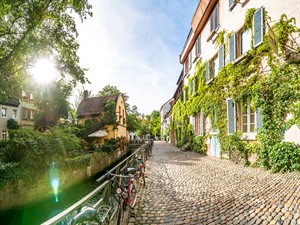
(1) Some cities grow by pushing nature further away. Freiburg, in south-west Germany, gives a different impression. It is a compact, historic city, but it does not feel trapped inside stone streets and office blocks. The Black Forest rises close to its edge, and within a short tram ride, city dwellers can leave the bustling centre and walk towards quiet valleys, wooded slopes and clear streams. This unusual closeness between urban life and natural scenery is one reason why Freiburg is often described as one of Europe’s greenest cities.
(2) The city centre is lively without feeling overwhelming. Narrow streets lead past cafés, galleries, small shops and old buildings, while students, commuters and visitors move through the same neighbourhoods. Freiburg has a large student population, so the atmosphere often feels youthful and vibrant. At the same time, the city has protected much of its historic character. Its old gates and squares remind visitors that this is not a newly invented eco-city, but a place where the past and the future stand side by side.
(3) Freiburg is also known for planning that makes everyday life more convenient. Many people travel by tram or bicycle, and some districts have been designed so that cars are less necessary. In Vauban, a neighbourhood often mentioned in discussions about sustainable living, homes are close to schools, shops and green spaces. This does not mean that life there is perfect or effortless. Housing can be expensive, and not every resident has the same advantages. Still, the district shows how a city can be organised more thoughtfully, so that streets become places for people rather than only routes for traffic.
(4) Beyond the city, the surrounding region offers a very different rhythm. Vineyards, farmland and small villages spread across the hills, and the landscape changes with the seasons. In spring and summer, meadows become lush and colourful; in autumn, the vineyards turn gold and red. The countryside around Freiburg is not just a relaxing background for tourists. It is also a working landscape, shaped by farming, local food production and regional traditions.
(5) However, popularity brings pressure. A place that is easy to reach can quickly become touristy, especially when visitors arrive only to take photographs and leave. Freiburg’s challenge is to remain welcoming without losing the calm, close-knit feeling that makes its neighbourhoods and surrounding villages special. Like many attractive places, it must balance development with protection.
(6) Perhaps the most interesting thing about Freiburg is that it does not present the city and the countryside as opposites. Instead, it shows how they can support each other. The city benefits from the forest, the hills and the nearby farmland, while the surrounding area benefits from the city’s schools, markets, transport and cultural life. Freiburg is not a perfect model, but it is a powerful example of a place where urban energy and natural beauty can flourish together.
(2) The city centre is lively without feeling overwhelming. Narrow streets lead past cafés, galleries, small shops and old buildings, while students, commuters and visitors move through the same neighbourhoods. Freiburg has a large student population, so the atmosphere often feels youthful and vibrant. At the same time, the city has protected much of its historic character. Its old gates and squares remind visitors that this is not a newly invented eco-city, but a place where the past and the future stand side by side.
(3) Freiburg is also known for planning that makes everyday life more convenient. Many people travel by tram or bicycle, and some districts have been designed so that cars are less necessary. In Vauban, a neighbourhood often mentioned in discussions about sustainable living, homes are close to schools, shops and green spaces. This does not mean that life there is perfect or effortless. Housing can be expensive, and not every resident has the same advantages. Still, the district shows how a city can be organised more thoughtfully, so that streets become places for people rather than only routes for traffic.
(4) Beyond the city, the surrounding region offers a very different rhythm. Vineyards, farmland and small villages spread across the hills, and the landscape changes with the seasons. In spring and summer, meadows become lush and colourful; in autumn, the vineyards turn gold and red. The countryside around Freiburg is not just a relaxing background for tourists. It is also a working landscape, shaped by farming, local food production and regional traditions.
(5) However, popularity brings pressure. A place that is easy to reach can quickly become touristy, especially when visitors arrive only to take photographs and leave. Freiburg’s challenge is to remain welcoming without losing the calm, close-knit feeling that makes its neighbourhoods and surrounding villages special. Like many attractive places, it must balance development with protection.
(6) Perhaps the most interesting thing about Freiburg is that it does not present the city and the countryside as opposites. Instead, it shows how they can support each other. The city benefits from the forest, the hills and the nearby farmland, while the surrounding area benefits from the city’s schools, markets, transport and cultural life. Freiburg is not a perfect model, but it is a powerful example of a place where urban energy and natural beauty can flourish together.
1. A state in which two places, people or ideas are near each other or strongly connected. (1)
The corresponding term is "".
2. Requiring little or no difficulty, work or struggle. (3)
The corresponding term is "".
3. The land, places or communities located around a particular town or city. (6)
The corresponding phrase is "".
Lai iesniegtu atbildi un redzētu rezultātus, Tev nepieciešams autorizēties. Lūdzu, ielogojies savā profilā vai reģistrējies portālā!