

Read the text about Trieste carefully. Decide whether each statement is True, False, or Not mentioned according to the text
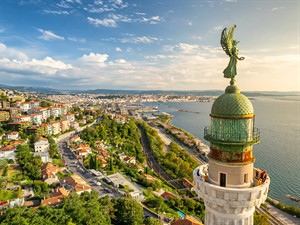
Trieste is not the Italy that many visitors expect. It has no Colosseum, no canals like Venice, and no leaning tower. Instead, it sits quietly at the north-eastern edge of the country, between the Adriatic Sea and the hills, close to Slovenia. For centuries, this position made Trieste an important harbour city, and even today, the sea shapes its identity.
Trieste initially gives the impression of elegance and tranquillity. Its city centre is compact, so it is easy to explore on foot. Wide streets lead to open squares, and the buildings often resemble Central European ones more than typical Italian ones. This is because Trieste once belonged to the Austro-Hungarian Empire, and its architecture still tells that story. In the historic centre, cafés are not just places to drink coffee; they are part of the city’s culture. Writers, students, office workers, and elderly neighbours have all used them as meeting places, reading rooms, and quiet corners for conversation.
One of the most attractive areas is the waterfront. Near the harbour, the city opens towards the sea, and people slow down here. Some are visitors taking photographs; others are commuters crossing the centre on their way to work. In the morning, buses, cars, and scooters can create a traffic jam near busy junctions, but a few streets away, the atmosphere may suddenly become peaceful again. This quick change from noise to calm is part of Trieste’s character.
The city is also full of layers. A short walk can take you from a lively square to a quiet church, from an old bookshop to a modern office block, or from a gallery to a narrow street where laundry hangs above the pavement. Trieste does not feel like an open-air museum, even though it has a strong sense of history. People still live, work, argue, shop, and hurry through these historic streets. That everyday life keeps the city real.
A few kilometres from the centre stands Miramare Castle, one of the most memorable places connected with Trieste. It rises above the sea, surrounded by a green park with paths, trees, and views of the water. The castle is magnificent. It looks more like a dream home than a fortress. Visitors can walk through its rooms and imagine a very different kind of city life: one shaped by wealth, power, and distance from ordinary streets.
However, Trieste is not perfect. Like many port cities, it has had to think carefully about old industrial spaces, transport, housing, and pollution. Some areas have been repaired or reused, while others still show the rougher side of urban life. This makes the city more interesting, not less. A beautiful city can still have problems, and an old city can still be changing.
Perhaps the best thing about Trieste is that it does not try too hard to impress. It is not as touristy as many famous Italian cities, and that gives it a different kind of charm. It is metropolitan, but not overwhelming; historic, but not frozen in the past; lively, but rarely chaotic. For a curious visitor, Trieste becomes a city of small discoveries: a quiet café, a sea view at the end of a street, a hidden courtyard, a sudden gust of wind, or a conversation overheard on a boulevard.
Trieste shows that a city does not need to be world-famous to be memorable. Sometimes the most fascinating places are the ones that stand slightly apart, where different languages, histories, and ways of life meet. In Trieste, the harbour, the hills, and the streets all seem to say the same thing: a city is not only a place on a map, but also a living story that keeps being rewritten.
Trieste initially gives the impression of elegance and tranquillity. Its city centre is compact, so it is easy to explore on foot. Wide streets lead to open squares, and the buildings often resemble Central European ones more than typical Italian ones. This is because Trieste once belonged to the Austro-Hungarian Empire, and its architecture still tells that story. In the historic centre, cafés are not just places to drink coffee; they are part of the city’s culture. Writers, students, office workers, and elderly neighbours have all used them as meeting places, reading rooms, and quiet corners for conversation.
One of the most attractive areas is the waterfront. Near the harbour, the city opens towards the sea, and people slow down here. Some are visitors taking photographs; others are commuters crossing the centre on their way to work. In the morning, buses, cars, and scooters can create a traffic jam near busy junctions, but a few streets away, the atmosphere may suddenly become peaceful again. This quick change from noise to calm is part of Trieste’s character.
The city is also full of layers. A short walk can take you from a lively square to a quiet church, from an old bookshop to a modern office block, or from a gallery to a narrow street where laundry hangs above the pavement. Trieste does not feel like an open-air museum, even though it has a strong sense of history. People still live, work, argue, shop, and hurry through these historic streets. That everyday life keeps the city real.
A few kilometres from the centre stands Miramare Castle, one of the most memorable places connected with Trieste. It rises above the sea, surrounded by a green park with paths, trees, and views of the water. The castle is magnificent. It looks more like a dream home than a fortress. Visitors can walk through its rooms and imagine a very different kind of city life: one shaped by wealth, power, and distance from ordinary streets.
However, Trieste is not perfect. Like many port cities, it has had to think carefully about old industrial spaces, transport, housing, and pollution. Some areas have been repaired or reused, while others still show the rougher side of urban life. This makes the city more interesting, not less. A beautiful city can still have problems, and an old city can still be changing.
Perhaps the best thing about Trieste is that it does not try too hard to impress. It is not as touristy as many famous Italian cities, and that gives it a different kind of charm. It is metropolitan, but not overwhelming; historic, but not frozen in the past; lively, but rarely chaotic. For a curious visitor, Trieste becomes a city of small discoveries: a quiet café, a sea view at the end of a street, a hidden courtyard, a sudden gust of wind, or a conversation overheard on a boulevard.
Trieste shows that a city does not need to be world-famous to be memorable. Sometimes the most fascinating places are the ones that stand slightly apart, where different languages, histories, and ways of life meet. In Trieste, the harbour, the hills, and the streets all seem to say the same thing: a city is not only a place on a map, but also a living story that keeps being rewritten.
1. The city’s position has helped create its strong connection with the sea.
According to the text, this statement is .
2. Trieste is described as a place where history is separate from ordinary daily life.
According to the text, this statement is .
3. The less polished aspects of Trieste are presented as weakening the city’s appeal.
According to the text, this statement is .
Atbilžu varianti:
true
false
not mentioned
Atsauce:
Picture “Trieste city in Italy”: Mazur Travel / Shutterstock.com
Lai iesniegtu atbildi un redzētu rezultātus, Tev nepieciešams autorizēties. Lūdzu, ielogojies savā profilā vai reģistrējies portālā!