

Read the article and study the survey results. Choose the correct answer by using information from both sources.
Source A:
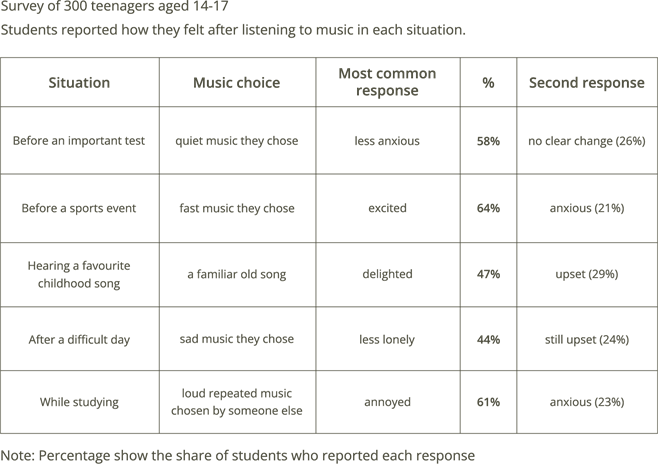
Music can change how we feel, but its effect is not as simple as “fast music makes us happy” or “slow music makes us sad”. Researchers have found that our reaction depends on several things, including the speed and volume of the music, the situation we are in and the memories connected with a song.
Fast music with a strong rhythm can increase energy and make people feel excited, especially before physical activity. However, the same music may have a different effect when someone is already anxious. If the volume is high or the sound is difficult to control, the listener may find it harder to relax.
Familiar music often produces stronger emotions than music we have never heard before. This is because songs can become connected with people, places and important events. A favourite song from the past may make someone feel delighted, while another familiar song may leave a listener upset because it brings back an unpleasant memory. The emotional reaction therefore depends partly on what the music represents to that person.
Music can also help people manage difficult moods. Some listeners choose calm music when they feel nervous or stressed. Others prefer songs that match their current mood. Surprisingly, sad music does not always make sadness stronger. For some people, it creates a feeling that another person understands their experience, which may help them feel less lonely.
Choice is also important. People often react more positively when they can choose what they hear. In contrast, music that is unwanted, repeated or too loud may make a person annoyed, particularly when they are trying to concentrate.
There is therefore no musical style that creates exactly the same emotion in everyone. Situation, memory, personal choice and purpose all influence the final reaction.
Fast music with a strong rhythm can increase energy and make people feel excited, especially before physical activity. However, the same music may have a different effect when someone is already anxious. If the volume is high or the sound is difficult to control, the listener may find it harder to relax.
Familiar music often produces stronger emotions than music we have never heard before. This is because songs can become connected with people, places and important events. A favourite song from the past may make someone feel delighted, while another familiar song may leave a listener upset because it brings back an unpleasant memory. The emotional reaction therefore depends partly on what the music represents to that person.
Music can also help people manage difficult moods. Some listeners choose calm music when they feel nervous or stressed. Others prefer songs that match their current mood. Surprisingly, sad music does not always make sadness stronger. For some people, it creates a feeling that another person understands their experience, which may help them feel less lonely.
Choice is also important. People often react more positively when they can choose what they hear. In contrast, music that is unwanted, repeated or too loud may make a person annoyed, particularly when they are trying to concentrate.
There is therefore no musical style that creates exactly the same emotion in everyone. Situation, memory, personal choice and purpose all influence the final reaction.
Source B:
1. Which survey result best supports the article’s opening idea that one type of music does not always produce one emotional response?
2. Why are the two main reactions to the childhood song especially important?
3. What connection can be made between the article’s explanation of loneliness and the survey?
Lai iesniegtu atbildi un redzētu rezultātus, Tev nepieciešams autorizēties. Lūdzu, ielogojies savā profilā vai reģistrējies portālā!