

1. The climate affects every living thing on Earth.
2. Today, the planet is heating up, sea levels are rising, and many ecosystems are changing under pressure.
3. Researchers have studied these changes for decades and have found clear links between human activity and global warming.
4. For years, they have been asking governments, businesses and ordinary people to act before the consequences become harder to control.
Grammar tenses are essential in English because they do much more than show time. They help us explain whether an action is general, temporary, completed, repeated, planned, predicted or still continuing. When we use tenses correctly, our message becomes clearer, more precise and easier to understand; when we use them incorrectly, the meaning of the whole sentence can change.
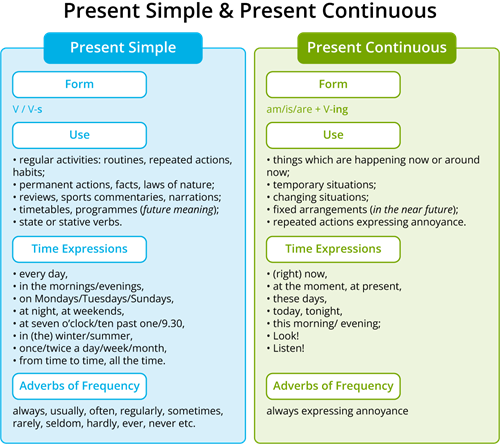
Can you name all the grammar tenses used in four introduction sentences? Can you explain how to use them correctly? These are present tenses, aren't the? You have already studied some of them. Let's go back for a bit to revise what was covered in Forms 3, 8 and 10!
Can you name all the grammar tenses used in four introduction sentences? Can you explain how to use them correctly? These are present tenses, aren't the? You have already studied some of them. Let's go back for a bit to revise what was covered in Forms 3, 8 and 10!
Revise: Present Simple – Formation, Spelling Rules, Usage, Present Continuous - Formation, Spelling Rules, Usage, Present Perfect Simple – Formation, Usage, Talking About Tomorrow: Ways to Express the Future
In a nutshell:
Learn: now, lets move on with Present Perfect Continuous in comparison with Present Perfect. Watch the video!
Key Takeaways:
Present Perfect Continuous
We form the Present Perfect Continuous with: have / has + been + verb-ing
Positive
I / you / we / they have been + verb-ing
he / she / it has been + verb-ing
Positive
I / you / we / they have been + verb-ing
he / she / it has been + verb-ing
Scientists have been studying climate change for decades.
The planet has been getting warmer.
Negative: have / has + not + been + verb-ing
Some governments have not been doing enough to reduce emissions.
The weather has not been following its usual patterns.
Question: Have / Has + subject + been + verb-ing?
Have temperatures been rising for many years?
Has Arctic ice been melting faster?
2. Usage Rules — Let's compare these tenses
Use Present Perfect for results and completed changes. Use this tense when the result is more important than the process. Use it when you want to show what has changed, happened or been completed by now.
Global temperatures have increased. (This means temperatures are higher now.)
Sea level has risen. (This means sea level is higher now.)
Scientists have recorded more heatwaves. (This focuses on what scientists have found up to now.)
Use Present Perfect Continuous for ongoing processes. Use it when the process is more important, especially if it is still continuing. Use Present Perfect Continuous when you want to show how long something has been happening or that the process is still active.
The planet has been getting warmer for decades. (This focuses on the long process of warming.)
Arctic ice has been melting for many years. (This focuses on the continuing process.)
Scientists have been warning people about climate risks. (This focuses on the repeated action over time.)
Use Present Perfect Continuous to emphasise duration. Present Perfect Continuous often makes the length of time feel stronger. This tense can emphasise the amount or length of time that has passed.
Researchers have studied global warming for decades. (The fact is important.)
Researchers have been studying global warming for decades. (The long period of research is emphasised.)
Use Present Perfect with numbers, amounts and completed quantities. Use Present Perfect, not Present Perfect Continuous, when the sentence includes how much or how many.
Scientists have recorded five major heatwaves this year. (Not: Scientists have been recording five major heatwaves this year.)
Sea level has risen by several centimetres. (Not: Sea level has been rising by several centimetres.)
Present Perfect can show completion; Present Perfect Continuous can show unfinished activity.
Researchers have written a report about climate change. (The report is finished.)
Researchers have been writing a report about climate change. (The work may still be continuing.)
Different present results. Sometimes both tenses explain a result in the present, but the focus is different. Present Perfect: result from a completed action. Present Perfect Continuous: result from the activity itself.
Examples:
Scientists have published the report, so people can read the results now. (The result comes from the completed report.)
Scientists have been collecting data, so they understand the changes better. (The result comes from the ongoing process.)
Scientists have been collecting data, so they understand the changes better. (The result comes from the ongoing process.)
Do not use Present Perfect Continuous with stative verbs. Some verbs describe states, not actions. These are called stative verbs.
Revise:
Use “for” and “since” with both tenses. Use "for" with a period of time: for many years / for decades / for a long time / for several months.
Use "since" with a starting point: since 2000 / since the beginning of the century / since the Industrial Revolution / since last summer.
Use "since" with a starting point: since 2000 / since the beginning of the century / since the Industrial Revolution / since last summer.
Temperatures have been increasing for many years.
Scientists have studied climate change since the 20th century.
Use “already” and “yet” mainly with Present Perfect. Use "already" when something has happened before now. Use "yet" in questions and negative sentences.
Scientists have already warned governments about climate risks.
Have countries reduced emissions yet?
Some countries have not reached net zero yet.
Have countries reduced emissions yet?
Some countries have not reached net zero yet.
Atsauce:
English with Lucy “The Present Perfect vs The Present Perfect Continuous | ALL differences” on youtube.com