

Prepositions of place
Revise what you have already learned about Prepositions of place!
Prepositions of place tell us where something is. They show the position or location of a person or thing in relation to something else. We use them when we describe places, give directions, or talk about where objects are.
In short:
Common prepositions of place are in, on, at, next to/beside, near/close to, behind, between, below, under, above, over, among, opposite and in front of:
- in for something inside a room, building, or area; = inside a container or a 3D space;
- on for something that is on a surface, = on top of a flat surface;
- at to talk about a specific point or place; = a point on a map or a functional stop;
- at the back / at the front for specific positions in a line or a room;
- next to and near to show that something is close;
- behind and in front of to show position at the back or the front;
- between for something in the middle of two things;
- under for something below, and above for something higher;
- among for something in the middle of many things or a group;
- opposite for something on the other side of a space or street, facing you;
- inside for something within the interior of a container or space;
- outside for something that is not in a building or room;
- by or beside for something that is right next to or at the side of another thing;
- below for something at a lower level (similar to under, but often for position);
- over for something covering a surface or moving across to the other side;
- against for something touching or leaning on a vertical surface like a wall.
Prepositions of place are always followed by a noun or pronoun.
My City Companion
Last weekend, I went on a short trip. To find my destination, I used my smartphone and a map app.
This digital map clearly showed my hotel's location and the best route for me. The distance from my house to the hotel was about ten kilometres. I followed the app's directions to navigate the city successfully.
The app guided me through the streets, showing me the best way around busy areas. I enjoyed learning how to use the app because it made my journey convenient and fun. On my way, I saw a beautiful park next to the museum, which was also marked on the map. I also checked the app to see the distance between my hotel and the main attractions. Thanks to the digital map, I didn’t get lost and had a great experience exploring the city.
This digital map clearly showed my hotel's location and the best route for me. The distance from my house to the hotel was about ten kilometres. I followed the app's directions to navigate the city successfully.
The app guided me through the streets, showing me the best way around busy areas. I enjoyed learning how to use the app because it made my journey convenient and fun. On my way, I saw a beautiful park next to the museum, which was also marked on the map. I also checked the app to see the distance between my hotel and the main attractions. Thanks to the digital map, I didn’t get lost and had a great experience exploring the city.
Word bank:
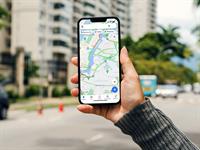
app — [æp] — noun; abbreviation for "application"; a computer program or piece of software designed for a particular purpose that you can download onto a mobile phone or other mobile device; lietotne
I downloaded a new weather app to check the forecast every morning.

destination — [ˌdɛstɪˈneɪʃən] — noun; the place where someone is going or where something is being sent or taken; galamērķis
Our final destination on the road trip is the beautiful beach town.
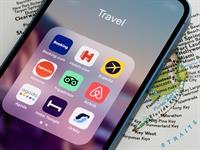
digital — [ˈdɪdʒ.ɪ.təl] — adj; showing information in the form of an electronic image; digitāls
Many museums now have digital exhibits that you can explore online.

distance — [ˈdɪstəns] — noun; the amount of space between two places; attālums
The distance between the two cities is about 200 kilometers.
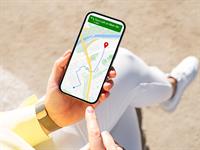
direction — [dɪˈrekʃən] — noun; the position towards which someone or something moves or faces; virziens
Can you give me direction to the nearest coffee shop?

location — [ləʊˈkeɪʃən] — noun; a place or position; atrašanās vieta
The restaurant’s location is right next to the park.

map — [mæp] — noun; a drawing that shows the roads, cities, and features of a place; karte
I used a map to find my way through the unfamiliar city.

navigate — [ˈnævɪgeɪt] — verb; to find a direction across, along, or over an area of water or land, often by using a map; orientēties
It’s easy to navigate the new software once you learn the basic functions.

route — [ruːt] — noun; a particular way or direction between places; maršruts
We planned the best route to avoid traffic during our trip.

smartphone — [ˈsmɑːtˌfəʊn] — noun; a mobile phone that can be used as a small computer and that connects to the internet; viedtālrunis
She uses her smartphone to stay connected with friends and family.
Atsauce:
App: Diego Thomazini / Shutterstock
Digital: Tada Images / Shutterstock
Distance: Wilman Muhamad Nurdin / Shutterstock