


Something Has Been Going On…
Tired eyes.
Messy hair.
A pile of books.
A half-finished notebook page.
A cup of tea on the desk.
These are clues.
Look at the student in the picture. She is not just sitting at a desk. She looks exhausted. Her books are open, her notes are spread out, and she is still trying to write, even though she looks ready to fall asleep. It is easy to imagine her saying: "I have been studying all evening." And that one sentence opens the door to our next grammar focus: the Present Perfect Continuous.
Messy hair.
A pile of books.
A half-finished notebook page.
A cup of tea on the desk.
These are clues.
Look at the student in the picture. She is not just sitting at a desk. She looks exhausted. Her books are open, her notes are spread out, and she is still trying to write, even though she looks ready to fall asleep. It is easy to imagine her saying: "I have been studying all evening." And that one sentence opens the door to our next grammar focus: the Present Perfect Continuous.
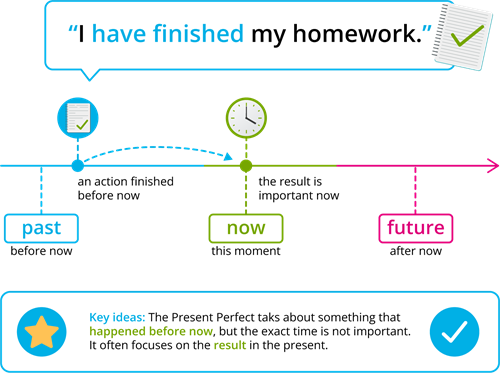
Revise before we explore the Present Perfect Continuous, let’s quickly revisit its close relative: the Present Perfect. You already know this tense from Form 8. It helps us connect something that happened before now with the present moment. So, before we move forward, open the revision link and remind yourself: Mental Health and Sports. Present Perfect Simple
In a nutshell:
Learn: now watch the video and explore how the Present Perfect Continuous works.
Key takeaways:
The Present Perfect Continuous is also called the Present Perfect Progressive. We use it to talk about an action that started in the past and continues up to now. Sometimes the action may also continue in the future.
She has been sleeping all day. (This means she started sleeping earlier today and continued for a long time. She may still be sleeping now, or she has just woken up and the result is clear.)
Snow has been falling all night. (This means the snow started falling during the night and continued for many hours. It may still be falling now, or we can see the result, for example snow on the ground.)
 Affirmative form: have / has + been + verb-ing
Use "have" with: I, you, we, they and plural nouns.
Use "has" with: he, she, it and singular nouns.
She has been reading a book.
The student has been doing her homework.
Contracted forms: in spoken and informal written English, we often use contractions. We can contract "have" and "has" with subject pronouns:
I have — I’ve
you have — you’ve
we have — we’ve
they have — they’ve
he has — he’s
she has — she’s
it has — it’s
I have — I’ve
you have — you’ve
we have — we’ve
they have — they’ve
he has — he’s
she has — she’s
it has — it’s
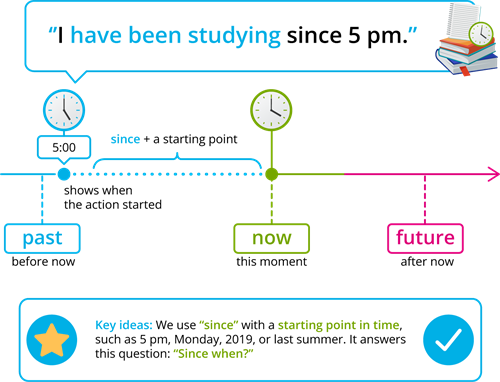
He’s been reading since 5 o’clock.
The student’s been doing her homework all evening.
We can also sometimes contract "has" with a singular subject noun. This means one person, one animal, one thing, or one named person.
Contraction: The student’s been revising all evening.
However, in formal writing, the full form is used:
The student has been revising all evening.
Emma has been working on her project.
However, in formal writing, the full form is used:
The student has been revising all evening.
Emma has been working on her project.
 Negative form: subject + have / has + not + been + verb-ing
She has not been revising enough this week.
Contractions:
have not — haven’t
has not — hasn’t
 Question form: (Question word)* / Have / Has + subject + been + verb-ing?
 Has she been sleeping all day?
How long have they been working on the project?
Revise what you studied about question words in Form 8: Passive Voice: Events in the Present
Key idea: the Present Perfect Continuous usually focuses on how long an action has been happening or shows that the action is still in progress now.
Signal words:
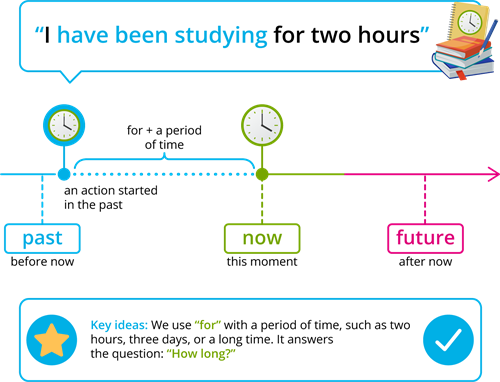
for + a period of time — used to show how long the action has continued
since + a starting point — used to show when the action started
Other signal words:
all + time expression — used to emphasise that the action continued through a whole period
Snow has been falling all night.
recently — used when an action has been happening during a recent period, often with a visible result or present relevance
lately — similar to "recently", but often suggests a repeated or continuing situation in the recent past
over the last / past + time period — used to show that something has been developing or continuing during a recent period
Students have been improving their study habits over the last few weeks.
these days — used for a current ongoing situation or repeated activity around the present time
so far — used to talk about progress up to now, especially when the situation is still continuing
recently / lately + question form — very common when asking about someone’s recent activity
How long … ? — a very strong question signal for Present Perfect Continuous when asking about duration
Present Perfect vs Present Perfect Continuous
I have finished my homework. (The homework is complete now.)
I have been doing my homework for two hours. (The action continued for some time, and the time/activity is important.)
Present Perfect often focuses on the result
Present Perfect Continuous often focuses on the activity or duration
Atsauce:
Ellii (formerly ESL Library) "Present Perfect Progressive – Grammar & Verb Tenses" on youtube.com