

More Than a Place on a Map
A story may begin in a village, a capital city or a house beside the sea. A strong setting tells us much more than where the characters are. It can reveal when they live, what kind of society surrounds them and even what choices are possible.
Time is one important part of setting. A story set in a particular decade may include technology, fashion and attitudes that immediately make it different from a story set today. A wider historical period can shape the characters’ everyday lives even more. Their education, work, family expectations and opportunities may all depend on the time in which they live.
Society matters too. In some stories, class affects where characters live, what work they can do and how other people treat them. A character from a wealthy family may experience the same city very differently from someone who has little money. These differences can create conflict long before the main plot begins
The political system can also influence a fictional world. It may determine how much freedom people have, who makes important decisions and what happens when someone disagrees with those in power. In some stories, political rules remain in the background. In others, they directly affect the characters’ lives.
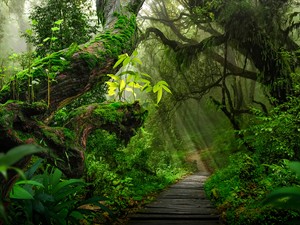
Then there is the physical world. Writers use scenery to help readers picture mountains, forests, coastlines or open countryside. But the same scenery can create very different effects depending on the situation. A quiet forest may seem peaceful during the day but threatening after dark.
Even the season can matter. A town during the tourist season may be crowded and lively, while the same streets may feel almost empty several months later. A farming community during harvest season will also have a different rhythm from the same place in winter.
All these details influence the mood of a story. A tense political situation, a divided society or an isolated landscape can create a very different atmosphere from a summer festival in a busy harbour town.
This is why setting is never just background information.
mood — [mu:d] — the way a group of people feel about something; the atmosphere in a place or among a group of people; garastāvoklis, noskaņojums;
setting — [ˈsetɪŋ] — an environment where something is located; the place at which something happens; apkārtne, vide.
Place and Time
The setting of a story describes where and when the events happen, as well as the environment and social world in which the characters live. The five main types of setting are:
- Physical setting — the geographical place where the story happens.
- Temporal setting — the time period or historical era of the story.
- Social and cultural setting — the customs, social groups and way of life shown in the story.
- Atmospheric or psychological setting — the mood or feeling created by the setting.
- Symbolic setting — a setting that represents a deeper idea, theme or meaning.
class — [klɑːs] — [countable + singular or plural verb] one of the groups of people in a society that are thought of as being at the same social or economic level; šķira;
decade — [ˈdekeɪd] [dɪˈkeɪd] — a period of ten years, especially a continuous period, such as 1910 — 1919 or 2000 — 2009; desmitgade;
period — [ˈpɪəriəd] — a particular length of time, especially a particular time in history; laikposms, periods;
political system — [pəˈlɪt.ɪ.kəl ˈsɪs.təm] — the way a country is organised and governed, including how political power is used and decisions are made; politiskā sistēma;
scenery — [ˈsiːnəri] — the natural features of an area that you can see; dabasskati, ainava;
season — [ˈsiːzn] — a period of time during a year when a particular activity happens or is done; sezona.
Revise vocabulary related to natural landscapes: Exploring Natural Landscapes, places in the city and the countryside: From Busy Streets to Open Fields, Exploring the Urban Jungle, A Journey Through the Countryside
How Real Places Become Fictional Worlds
A writer does not always have to invent a place from nothing. Many fictional worlds begin with real locations — a street the writer knows, a historic building, an ancient town or even a quiet stretch of shore.
Real places provide details that are difficult to invent convincingly. A writer walking through an old district may notice narrow streets, unusual buildings, local cafés or the way people move through the area. These small observations can make a fictional setting feel more believable.
Sometimes the inspiration comes from somewhere less familiar. Writers may visit a remote village, an island or an isolated mountain community to understand what daily life is like there. Distance from large towns can affect transport, work, communication and even relationships between characters.
Coastal settings offer another kind of atmosphere. A working harbour can be noisy and lively, filled with boats, workers and visitors. A few kilometres away, the same coastline may become completely quiet. The contrast between a crowded harbour and an empty shore can give a writer very different possibilities for a story.
Old places can be especially powerful. Ruins immediately suggest that something existed there before. They may be the remains of a castle, a town or another historical structure. A writer can use such places to connect the present with events from the past.
However, historic and historical do not mean exactly the same thing. A historic site is important because something significant happened there or because it has special importance in history. Something historical, by contrast, is simply connected with the past. A novel about life in the eighteenth century, for example, is a historical novel.
Size can also affect how readers experience a place. An enormous castle may make a character seem small and powerless, while a tiny room can create a completely different feeling.
Writers may change real locations, combine several places or move events somewhere else entirely. But the details they collect from real places help fictional settings feel convincing.
Setting Features and Details
ancient — [ˈeɪnʃənt] — from a very long time ago; sens, senslaicīgs;
district — [ˈdɪstrɪkt] — a particular part of a town, city or country; rajons, apvidus;
enormous — [ɪˈnɔː.məs] — extremely large; milzīgs (amer. briesmīgs, šausmīgs);
familiar — [fəˈmɪliə(r)] — well known to you; often seen or heard and therefore easy to recognize; pazīstams, parasts;
harbour — [ˈhɑːbə(r)] — an area of water near the coast where ships and boats can stay safely; osta;
historic — [hɪˈstɒrɪk] — important in history or connected with an important event from the past; vēsturiski nozīmīgs, vēsturiskas nozīmes;
historical — [hɪˈstɒrɪkl] — connected with people, events or periods from the past; vēsturisks
historic — [hɪˈstɒrɪk] — important in history or connected with an important event from the past; vēsturiski nozīmīgs, vēsturiskas nozīmes;
historical — [hɪˈstɒrɪkl] — connected with people, events or periods from the past; vēsturisks
lively — [ˈlaɪvli] — full of energy, activity and interest; dzīvīgs, rosīgs;
remote — [rɪˈməʊt] — far away from places where other people live; tāls, attāls;
ruins — [ˈruːɪnz] — the broken parts that remain of an old building or town; drupas;
shore — [ʃɔː(r)] — the land along the edge of the sea or a lake; krasts, piekraste;
site — [saɪt] — a place where something is, was or happened, especially something important; atrašanās vieta, novietne.
site — [saɪt] — a place where something is, was or happened, especially something important; atrašanās vieta, novietne.
Why Setting Can Change the Whole Story
Imagine the same story taking place in two different locations. In one version, a teenager gets lost in a busy city centre. In another, the same teenager gets lost on a remote island. The basic problem is similar, but the setting changes almost everything.
Writers use setting to set the scene before the main action begins. A description of crowded streets, bright signs and constant traffic can create a lively atmosphere, while an empty road beside a dark forest may create a completely different feeling.
Small details can add to the atmosphere. A harbour filled with fishing boats and voices may seem active and welcoming. A house surrounded by empty fields may feel isolated even before anything unusual happens.
These details also help the reader imagine the place. The writer does not need to describe every object. A few carefully chosen details can give the reader a sense of distance, danger or comfort and allow them to build the rest of the picture in their own mind.
Setting can also control expectations. A character walking alone through ancient ruins after sunset may make the reader expect danger, even if nothing frightening has happened yet. In this way, description can set the mood before the plot changes.
Writers can also use setting to make the reader feel nervous, excited or relaxed. A lively festival may create excitement, while an isolated building can make the setting feel uncomfortable or unsafe. The location itself has not changed, but the way it is presented affects the reader’s reaction.
Most importantly, setting can affect what happens in the story. A storm can prevent a character from leaving an island. A crowded district may make it difficult to follow someone. A remote location may leave the characters without help. In these cases, setting does not simply provide background information — it begins to control the action.
This is why setting can play an important part in the story. It can influence the characters’ choices, create expectations, shape the reader’s emotions and even change the direction of the plot.
A strong setting does not sit quietly behind the story. It works with the story.
Talking about Setting and Atmosphere
affect what happens in the story — influence the events of the story; ietekmēt to, kas notiek stāstā;
be filled with something — have a lot of something in a place; būt piepildītam ar kaut ko;
be surrounded by something — have something on all sides; būt ieskautam ar kaut ko;
create a / an … atmosphere — make a place or scene have a particular feeling; radīt … atmosfēru;
give the reader a sense of … — help the reader experience or understand a particular feeling or quality; radīt lasītājam sajūtu vai priekšstatu par …;
help the reader imagine the place — make it easier for the reader to form a picture of the place in their mind; palīdzēt lasītājam iztēloties vietu;
make the reader expect something — cause the reader to think that something is likely to happen; likt lasītājam sagaidīt, ka kaut kas notiks;
make the reader feel + adjective — cause the reader to experience a particular feeling; likt lasītājam justies …;
make the setting feel + adjective — give the setting a particular feeling or quality; likt darbības videi šķist …;
play an important part in the story — have an important effect on the story; būt nozīmīgai lomai stāstā;
set the mood — create a particular feeling or atmosphere; radīt noskaņu;
set the scene — describe or show the place and situation in which something happens; iezīmēt darbības vidi, radīt ainu.

Setting in Focus
A strong answer does more than name a place. Explain how the setting influences the characters, the atmosphere or the events of the story.
A strong answer does more than name a place. Explain how the setting influences the characters, the atmosphere or the events of the story.
1. How can the same story change if it is set in a different place?
Model answer:
From my point of view, changing the location can completely change the way a story develops. For example, a character who gets lost in a lively city will face different problems from someone who gets lost in a remote area. The surroundings can affect what happens in the story because they influence what the character can see, do or use. A different location can also create a different atmosphere and make the reader feel more relaxed, curious or nervous. All in all, the setting can change both the mood and the direction of the plot.
2. Why is the time period important in a story?
Model answer:
As I see it, the time period can have a strong influence on the characters’ lives and decisions. A story set in an earlier decade may take place in a world without smartphones, modern transport or instant communication. Social expectations may also be different, and the political system may affect how much freedom the characters have. These details help the reader imagine the historical setting and understand why characters behave in particular ways. For these reasons, the period is often much more than background information.
3. Can a setting be important even when very little happens there?
Model answer:
It seems to me that a setting can be important even when there is very little action. A writer can use scenery and small details to create a particular atmosphere before anything significant happens. For instance, ancient ruins on an empty shore may make the reader expect something unusual, while a lively harbour can create a completely different mood. The setting can therefore prepare the reader emotionally for later events. In a nutshell, a place can influence the story even before the action begins.
4. What makes a fictional setting believable?
Model answer:
From my perspective, a believable setting needs carefully chosen details rather than a very long description. A writer can mention familiar sounds, buildings, scenery or everyday activities to help the reader imagine the place. Historical details should also match the period in which the story is set. If these details are consistent, even an invented place can feel realistic. To sum up, a convincing setting depends on details that fit together and make the fictional world easy to imagine.