

Read the text about the Latvian folk costume. For each gap, write between one and three words that best complete the sentence. Use only information from the text. Write the word(s) exactly as they appear in the text.
The missing words may be nouns, verbs, adjectives, or short phrases. Make sure your answer is grammatically correct and fits the meaning of the sentence.
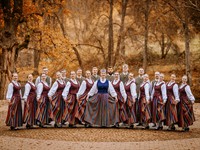
The Latvian folk costume is an important part of Latvia’s cultural heritage. It is not just traditional clothing from the past, but a symbol of identity, history, and belonging. Even today, people in Latvia proudly wear folk costumes at festivals, song and dance celebrations, weddings, and other national events.
Latvian folk costumes developed over many centuries. In the past, people made their own clothes from natural materials such as linen and wool. Linen was usually used for shirts and blouses, while wool was popular for skirts, coats, and shawls. Because everything was handmade, making one full costume took a lot of time and skill. The clothes were strong and practical, but they were also carefully decorated to show beauty and meaning.
One of the most interesting features of the Latvian folk costume is that it looks different in each region. Latvia has several cultural regions, and each one has its own colours, patterns, and clothing details. Some regions are known for bright red skirts, while others prefer darker colours such as blue, green, or brown. By looking at a costume, people can often tell where the wearer comes from.
Women’s folk costumes usually include a long skirt, a blouse, a sleeveless jacket, and an apron. The apron was not only decorative but also practical, as it protected the skirt during daily work. Belts are another important part of the costume. They are often woven with traditional patterns and symbols. People believed these patterns could protect the wearer and bring good luck. In the past, belts also showed whether a woman was married or not married.
Men’s folk costumes are usually simpler but still meaningful. They often include linen shirts, wool trousers, sleeveless jackets, and long coats. Hats and belts complete the outfit. Like women’s clothing, men’s costumes also vary by region and can show a person’s position in the community or their type of work.
Colour plays an important role in Latvian folk costumes. Red is one of the most common colours and is often linked with life, energy, and protection. White is connected with cleanliness and light, while blue is linked to the sky and nature. These colours were not chosen by chance; they came from traditional beliefs passed down through generations.
Patterns are another key element. Many costumes include geometric designs, such as lines, crosses, and stars. These symbols appear not only on clothing but also in Latvian folk art, songs, and decorations. Each pattern has a meaning, often connected with nature, family, or the cycle of life.
Today, Latvian folk costumes are carefully preserved. Museums collect original costumes, and craftsmen make them again using traditional methods. Schools and cultural groups teach young people about their meaning so that this knowledge is not lost.
Latvian folk costumes developed over many centuries. In the past, people made their own clothes from natural materials such as linen and wool. Linen was usually used for shirts and blouses, while wool was popular for skirts, coats, and shawls. Because everything was handmade, making one full costume took a lot of time and skill. The clothes were strong and practical, but they were also carefully decorated to show beauty and meaning.
One of the most interesting features of the Latvian folk costume is that it looks different in each region. Latvia has several cultural regions, and each one has its own colours, patterns, and clothing details. Some regions are known for bright red skirts, while others prefer darker colours such as blue, green, or brown. By looking at a costume, people can often tell where the wearer comes from.
Women’s folk costumes usually include a long skirt, a blouse, a sleeveless jacket, and an apron. The apron was not only decorative but also practical, as it protected the skirt during daily work. Belts are another important part of the costume. They are often woven with traditional patterns and symbols. People believed these patterns could protect the wearer and bring good luck. In the past, belts also showed whether a woman was married or not married.
Men’s folk costumes are usually simpler but still meaningful. They often include linen shirts, wool trousers, sleeveless jackets, and long coats. Hats and belts complete the outfit. Like women’s clothing, men’s costumes also vary by region and can show a person’s position in the community or their type of work.
Colour plays an important role in Latvian folk costumes. Red is one of the most common colours and is often linked with life, energy, and protection. White is connected with cleanliness and light, while blue is linked to the sky and nature. These colours were not chosen by chance; they came from traditional beliefs passed down through generations.
Patterns are another key element. Many costumes include geometric designs, such as lines, crosses, and stars. These symbols appear not only on clothing but also in Latvian folk art, songs, and decorations. Each pattern has a meaning, often connected with nature, family, or the cycle of life.
Today, Latvian folk costumes are carefully preserved. Museums collect original costumes, and craftsmen make them again using traditional methods. Schools and cultural groups teach young people about their meaning so that this knowledge is not lost.
1. Although it may seem like old clothing, the Latvian folk costume represents that connects people to their past.
2. While the clothes were strong and useful in everyday life, they were also created to show both , not only function.
3. The choice of colours followed long-standing ideas rather than coincidence, as they were rooted in shared across generations.
Atsauce:
Picture "Latvian folk dancers": shulers / Shutterstock.com
Lai iesniegtu atbildi un redzētu rezultātus, Tev nepieciešams autorizēties. Lūdzu, ielogojies savā profilā vai reģistrējies portālā!