

Read the text carefully. Then complete each sentence with one or two words.
Write the word(s) exactly as they appear in the text.
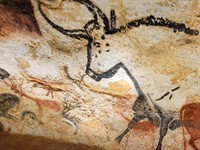
The Lascaux Cave paintings are often admired for their beauty, but they also reveal how carefully prehistoric people planned their work. These paintings were not created quickly or randomly. Instead, they required time, preparation, and cooperation among members of the group.
Before painting, people had to prepare the cave walls. Some surfaces were cleaned, while others were chosen because their natural curves helped create stronger images. People often worked in narrow, dark passages, which meant they needed artificial light. Archaeologists believe that stone lamps filled with animal fat were used to light the space. This limited light would have created moving shadows, making the painted animals appear more alive.
Another less obvious detail is how layers of paint were used. In some places, animals were painted on top of older images. This suggests that the cave was used repeatedly over long periods of time. It also shows that later people respected the earlier paintings and carefully added new images without destroying the old ones.
The paintings also show a clear understanding of materials. Different pigments were chosen for different effects. Dark colours were used for strong outlines, while lighter colours helped create depth. In some cases, people blew paint through hollow bones to cover large areas quickly, leaving soft edges instead of sharp lines.
Interestingly, not all animals shown were commonly hunted. Some of the most frequently painted animals were dangerous or rarely eaten. This suggests that the paintings were not simple hunting records. Instead, they may have expressed ideas about power, fear, or respect for nature.
Taken together, these details show that the Lascaux paintings were part of a complex cultural practice. They reflect knowledge, skill, and shared beliefs, proving that prehistoric people were thoughtful planners and creative thinkers, not just survivors of a harsh environment.
Before painting, people had to prepare the cave walls. Some surfaces were cleaned, while others were chosen because their natural curves helped create stronger images. People often worked in narrow, dark passages, which meant they needed artificial light. Archaeologists believe that stone lamps filled with animal fat were used to light the space. This limited light would have created moving shadows, making the painted animals appear more alive.
Another less obvious detail is how layers of paint were used. In some places, animals were painted on top of older images. This suggests that the cave was used repeatedly over long periods of time. It also shows that later people respected the earlier paintings and carefully added new images without destroying the old ones.
The paintings also show a clear understanding of materials. Different pigments were chosen for different effects. Dark colours were used for strong outlines, while lighter colours helped create depth. In some cases, people blew paint through hollow bones to cover large areas quickly, leaving soft edges instead of sharp lines.
Interestingly, not all animals shown were commonly hunted. Some of the most frequently painted animals were dangerous or rarely eaten. This suggests that the paintings were not simple hunting records. Instead, they may have expressed ideas about power, fear, or respect for nature.
Taken together, these details show that the Lascaux paintings were part of a complex cultural practice. They reflect knowledge, skill, and shared beliefs, proving that prehistoric people were thoughtful planners and creative thinkers, not just survivors of a harsh environment.
1. The paintings were produced through a planned process rather than being done .
2. The repeated use of the same cave suggests activity continued over .
3. People selected pigments carefully in order to create .
Atsauce:
Picture "Lascaux Cave": MisterStock / Shutterstock.com
Lai iesniegtu atbildi un redzētu rezultātus, Tev nepieciešams autorizēties. Lūdzu, ielogojies savā profilā vai reģistrējies portālā!